
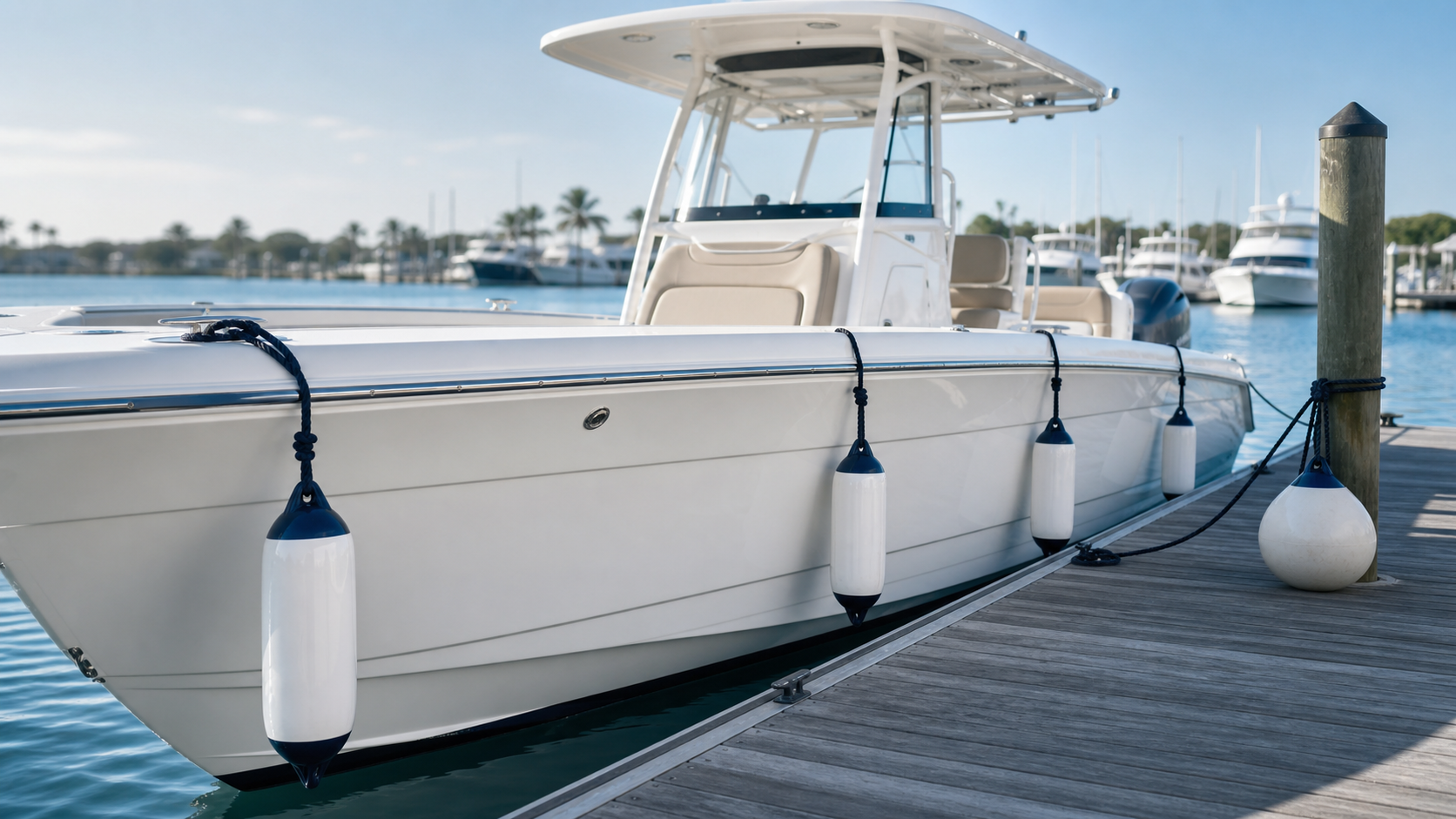
A 25-foot center console needs more than a couple of small fenders tossed in a cockpit locker. The right setup protects the hull, rub rail, and gelcoat when you are docking in wind, tied up at a restaurant, or spending the afternoon alongside another boat.
For most 25-foot center consoles, the practical starting point is three cylindrical fenders measuring roughly 8 to 8.5 inches in diameter and 26 to 27 inches long, plus at least one larger ball fender or a fourth cylindrical fender for extra protection.
Quick recommendation for a 25-foot center console
- Primary fenders: Three or four cylindrical fenders, approximately 8 to 8.5 inches by 26 to 27 inches.
- Backup or specialty fender: One 15- to 18-inch ball fender for pilings, rough docks, rafting up, or an exposed corner.
- Fender lines: Use dedicated, adjustable fender lines for every fender. Avoid tying fenders directly to railings with knots that are difficult to adjust.
- Minimum onboard setup: Three cylindrical fenders and three lines.
- Better all-around setup: Four cylindrical fenders, four lines, and one ball fender.
Affiliate disclosure: Brighter Boater may earn a commission from qualifying purchases through the retailer links below, at no additional cost to you.
Best fender setup by docking situation
| Situation | Best starting setup | Why |
|---|---|---|
| Normal floating dock | Three 8–8.5 × 26–27 in. cylinders | Covers the bow quarter, beam, and aft quarter |
| Fixed dock or frequent wakes | Four cylinders | Adds coverage as tide and boat position change |
| Pilings, corners, or rafting | Cylinders plus one 15–18 in. ball fender | Handles concentrated contact points |

Matched to this guide
Seafit 8.5" × 27" Fender, Black
This exact size matches the guide’s recommended starting range for a 25-foot center console.
- 8.5-inch diameter × 27-inch length
- Two rope eyes for vertical or horizontal hanging
Fit guidance: Plan on three or four cylindrical fenders for most boats in this class.
What size fenders should you buy?
A common sizing rule is to use about one inch of cylindrical-fender diameter for every four to five feet of boat length. The arithmetic for a 25-foot boat is about 5 to 6.25 inches; that rough rule is not the basis for our larger 8- to 8.5-inch recommendation. Use the specific fender maker’s boat-size guidance, displacement, windage and dock exposure. See West Marine’s fender-sizing guide. In real-world use, however, many center consoles benefit from choosing the larger end of the range.
Center consoles often have relatively high freeboard, pronounced hull sides, wide rub rails, and wind exposure at the dock. An 8- to 8.5-inch diameter fender offers a more forgiving cushion than a smaller 6.5-inch model, especially at fixed docks or when wakes are rolling through the marina.
Fender length matters, too. A fender around 26 to 27 inches long provides enough vertical coverage for most 25-foot center-console hulls without becoming awkward to stow. If your boat has unusually high sides or regularly encounters tall fixed docks, stepping up one size can be worthwhile.
How many fenders do you need?
Three fenders is the minimum useful number for a 25-foot center console. Four is better if storage allows.
With three fenders, you can protect the bow quarter, midship area, and stern quarter on the docking side. That arrangement covers the areas most likely to contact a dock during a normal side tie.
A fourth cylindrical fender adds flexibility. You can use it on the opposite side before entering a slip, protect an exposed stern corner, double up at a bad dock section, or keep it ready for rafting up with another boat.
For boaters who regularly encounter pilings, bulkheads, rough water, or crowded fuel docks, a ball fender is a smart addition rather than a replacement for the cylindrical fenders.
Where to place fenders on a 25-foot center console
For a standard alongside tie-up, hang cylindrical fenders at three points on the dockside:
- Forward quarter: Position the first fender roughly one-quarter of the boat length back from the bow. This helps protect the forward hull when approaching or leaving the dock.
- Midship: Put the second fender near the widest part of the boat, usually close to the console area. This is often the most important fender because the beam is greatest here.
- Aft quarter: Hang the third fender forward of the transom, where it can protect the aft hull side and stern corner.
Set the fenders so their centers sit near the point where the hull is most likely to touch the dock. On many center consoles, that means the fender should hang low enough to protect the hull side below the rub rail, not simply rest on top of the dock edge.
Before committing to a dock line, look at the dock height, tide, and shape of the dock face. A fender that is perfectly positioned at low tide may be too high or too low later in the day.
Cylindrical fenders vs. ball fenders
Cylindrical fenders
Cylindrical fenders are the everyday choice for most docking situations. They are easy to hang vertically, distribute protection along a section of hull, and fit well against flat dock faces.
Use cylindrical fenders for:
- Fixed or floating docks with relatively flat faces
- Restaurant docks and fuel docks
- Normal slips
- Rafting alongside another boat in calm conditions
- General-purpose protection while maneuvering
Ball fenders
Ball fenders have more volume and are particularly useful where contact is concentrated at one point. They do not replace a full set of cylindrical fenders, but they are excellent insurance for awkward docking situations.
Use a ball fender for:
- Pilings and round posts
- Dock corners
- Bulkheads
- High-wake marinas
- Rafting up with larger boats
- Protecting a specific contact point during a difficult tie-up
For a 25-foot center console, a ball fender in the 15- to 18-inch range is a useful companion to your regular cylindrical fenders. Hang it where a piling or dock corner is likely to meet the hull.
What changes at a fixed dock?
Fixed docks stay at one height while your boat rises and falls with tide and wake. That makes fender adjustment more important than at a floating dock.
At a fixed dock, use longer fender lines and check the fenders after the boat settles into its normal tide position. Match the fender to the actual hull-to-dock contact point; a higher dock edge may require a higher fender position, while exposed pilings can require another arrangement. Check protection through the expected tide range rather than always lowering the fenders.
Pay attention to the dock structure itself. A fixed dock can have exposed pilings, sharp corners, ladder brackets, cleats, or uneven boards. Place an extra cylindrical fender or a ball fender at the specific point where the boat could make contact.
In areas with a large tidal range, consider using adjustable fender hangers or simple quick-adjust fender knots so you can reset height quickly without retying every line.
What changes around pilings?
Pilings create point loads rather than broad, flat contact. A small cylindrical fender can slide around a piling or leave too little cushion between the hull and the post.
When tying alongside pilings, add a ball fender at the expected contact point and keep cylindrical fenders positioned ahead of and behind it. This combination protects both the concentrated point of contact and the surrounding hull.
Make sure the fenders can move with the boat as it shifts, but do not leave so much slack that the boat can get behind a fender and touch the piling directly. In wind or current, inspect the setup after the boat is fully secured.
Fender setup mistakes to avoid
- Buying fenders that are too small: Small fenders are easier to store, but they provide less protection when conditions are poor.
- Using only two fenders: Two may work briefly at a calm dock, but three is the practical minimum for a boat this size.
- Hanging fenders too high: A fender sitting above the contact area cannot protect the hull.
- Relying on the rub rail alone: Rub rails help with light contact, but they are not a substitute for properly positioned fenders.
- Leaving fenders deployed while running: Bring them aboard after departure. Fenders can chafe, catch lines, obstruct visibility, and look like an invitation for unnecessary commentary at the fuel dock.
- Ignoring changing tide and wake: Recheck fender height and line tension after conditions change.
Bottom line
For most 25-foot center consoles, buy three or four 8- to 8.5-inch by 26- to 27-inch cylindrical fenders and carry one 15- to 18-inch ball fender for pilings, corners, and rougher docking conditions. Place the cylindrical fenders at the forward quarter, widest midship point, and aft quarter, then adjust their height to match the dock.
If you frequently use fixed docks or tie up around pilings, the extra ball fender and a fourth cylindrical fender are well worth the locker space. A properly sized fender setup is cheaper than gelcoat repair and makes every docking situation less stressful.
Check the current price and availability of the matched 8.5 × 27-inch fender at West Marine.