
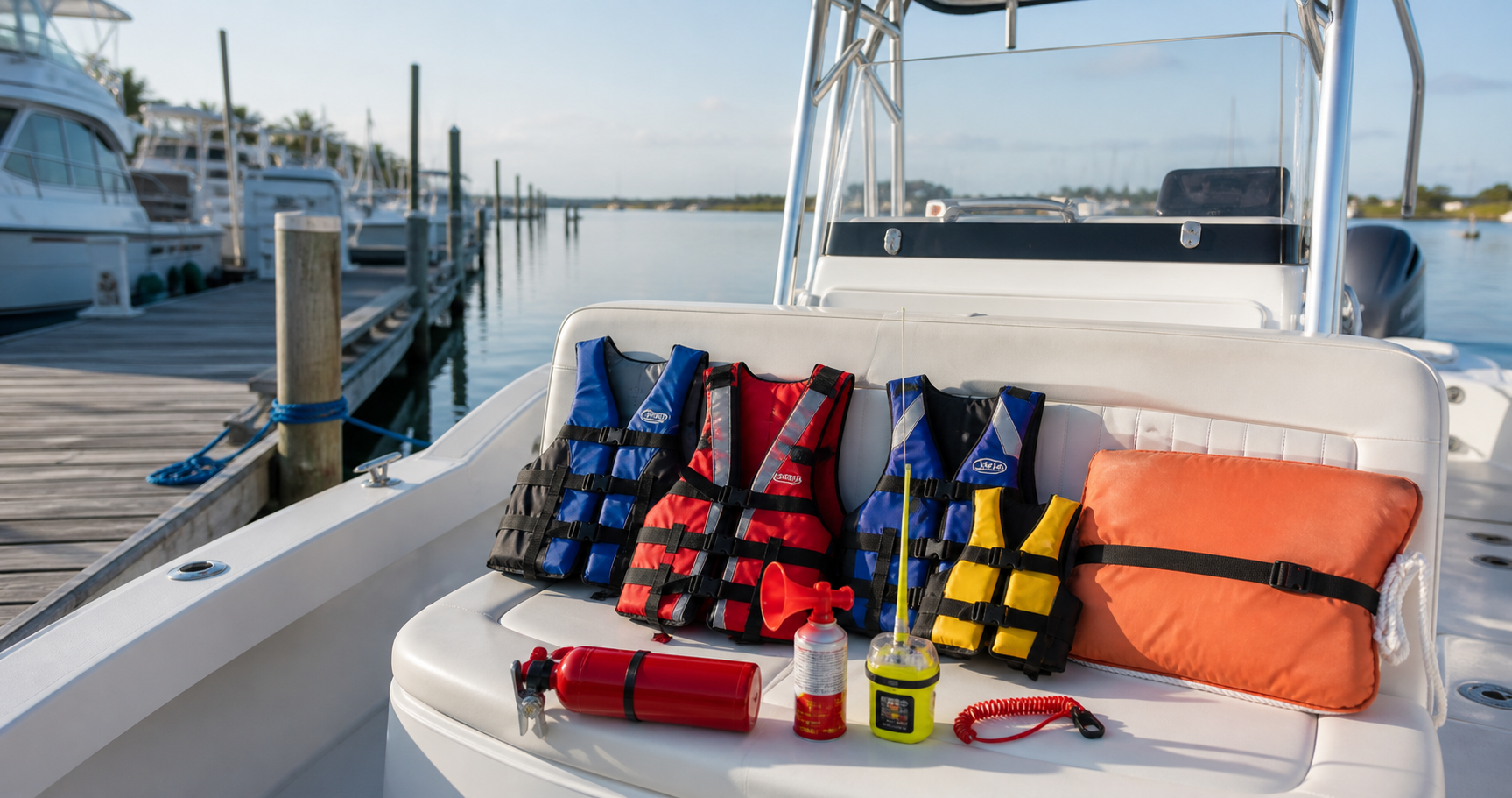
Before the first launch, do not buy a random “boat safety kit” and assume the box has you covered. Start with one properly sized, U.S. Coast Guard-approved wearable life jacket for every person aboard, then work through the requirements your boat triggers by length, fuel arrangement, operating waters, and whether you will be out after dark. Federal rules are the floor; your state and local waters may add to them.
The quick decision tree
- Every recreational boat: Carry one serviceable, readily accessible wearable PFD for each person aboard.
- Boat is 16 feet or longer: Add one immediately available throwable PFD, unless it is a canoe or kayak.
- Recreational motorboat under 26 feet, rated at 115 pounds of static thrust or more (about 3 hp), with an installed engine cut-off switch: Use the engine cut-off switch link when operating on plane or above displacement speed, unless the main helm is inside an enclosed cabin.
- Boat has specified fuel or enclosed-compartment fire hazards: Carry the correct number and rating of marine fire extinguishers for its length and model year.
- Operating on coastal waters, the Great Lakes, territorial seas, or certain connecting waters: Carry compliant day-and-night visual distress signals, subject to limited exemptions.
- Operating after sunset, before sunrise, or in restricted visibility: Your navigation lights must work and be appropriate for the boat’s type and length.
- Any recreational vessel: Have a sound-producing device appropriate to its length. A human voice does not count.
- 26 feet and longer, or a boat with machinery spaces, toilets, or other installed systems: Check the additional placard, pollution-control, sanitation, and Navigation Rules carriage requirements.
Use the current U.S. Coast Guard federal requirements guide as the detailed reference for your exact boat. A dealer-installed accessory, a previous owner’s gear bag, or a navigation-light switch on the dash is not proof that the boat is presently compliant.
New-owner shopping list
What to buy first—and when the rule actually applies
Start with the first two items, then add the conditional equipment your boat and operating area require. The product photos are representative examples; always confirm the Coast Guard approval label, size, rating, compatibility, and your state rules before ordering.
Affiliate disclosure: Brighter Boater may earn a commission from purchases through these links, at no additional cost to you.

REQUIRED • EVERY BOAT
One wearable PFD per person
Choose a Coast Guard-approved model in the correct size for each adult and child, and match it to the activity. Keep every jacket serviceable and readily accessible.

REQUIRED • 16 FT AND LONGER
One throwable PFD
Most recreational boats 16 feet and longer need one immediately available throwable device. The federal exception includes canoes and kayaks.

CONDITIONAL • POWERBOATS
Compatible ECOS lanyard or key
If your covered motorboat has an installed engine cut-off switch, use its link when the rule applies. Verify the key or clip matches your exact helm switch.

CONDITIONAL • MANY POWERBOATS
Marine fire extinguisher
Buy the quantity and Coast Guard rating triggered by your boat’s length, model year, fuel installation, and enclosed spaces. A 5-B unit is not a universal one-size answer.

CONDITIONAL • OPERATING WATERS
Visual distress signals
Coastal waters, the Great Lakes, territorial seas, and certain connecting waters trigger day/night signal rules, with limited exemptions. Confirm the exact approval and expiration status.

REQUIRED • EVERY VESSEL
Efficient whistle or horn
Carry a sound-producing device appropriate to your vessel’s length. Your voice does not satisfy the rule, and boats 12 meters or longer have more specific requirements.
Before ordering: Federal requirements are the baseline. Your state can add child-wear ages, boater-education rules, skier/towing equipment, flags, local-water restrictions, and other requirements.
Navigation lights are different: most boats already have them installed. Test every light before the first trip. If repair or replacement is needed, shop navigation lights matched to your exact vessel type, length, visibility range, mounting position, and wiring; a pair of red/green sidelights alone is not a complete lighting plan for every boat.
1. Wearable life jackets: required on every recreational boat
You need one U.S. Coast Guard-approved wearable PFD for each person aboard. Each must be the correct size for its intended wearer, in good condition, suitable for the activity, and readily accessible. “Readily accessible” means people can get it on quickly during a fire, capsize, or sudden sinking—not buried in a plastic bag under the cooler.
For children, fit matters more than the number printed on the chest. Check the user-weight range and tighten the PFD until it is snug but does not restrict breathing. Under federal law, children younger than 13 must wear an appropriate approved PFD while the boat is underway, unless they are below deck or in an enclosed cabin. Where a state has a different child life-jacket wear requirement, that state requirement applies on waters within its jurisdiction; check the applicable age and exemptions before departure. The USCG life-jacket FAQ explains this state-jurisdiction exception. Inflatable PFDs also have label limitations; do not assume an adult inflatable satisfies the requirement for a child or for a high-impact activity such as tubing.
A PFD stored aboard meets the minimum carriage rule; a PFD worn before the dock lines come off is far more useful when the unexpected happens close to shore. The Coast Guard’s life-jacket requirements and stowage guidance are worth reading before you assign seats and gear lockers. USCG boating-safety FAQs
2. Throwable PFD: usually required at 16 feet and up
A recreational boat 16 feet or longer must also carry one U.S. Coast Guard-approved throwable PFD, often called a Type IV device. Canoes and kayaks are exempt from this particular federal requirement regardless of length.
Keep the ring buoy, cushion, or horseshoe immediately available: on the open deck, within arm’s reach, or otherwise easy to grab without opening a hatch. A throwable is for getting flotation to someone in the water; it does not replace wearable life jackets for the people already aboard.
3. Engine cut-off switch link: use it when your boat is covered
An engine cut-off switch shuts down propulsion if the operator is unexpectedly separated from the helm. The small coiled lanyard or electronic fob that connects the operator to the switch is the engine cut-off switch link, often shortened to ECOSL.
If you operate a recreational motorboat under 26 feet, rated at 115 pounds of static thrust or more (about 3 hp), that has an engine cut-off switch installed, federal law generally requires you to wear or attach the link while the boat is on plane or moving above displacement speed. You do not need to wear it while idling or performing docking maneuvers. The principal exception is a boat whose main helm is inside an enclosed cabin. A covered boat built on or after January 1, 2020—under 26 feet and capable of roughly 3 horsepower or more—was generally required to be built with an engine cut-off device, and the owner must keep that system working.
The failure chain is simple: an operator is thrown clear, the boat keeps making power, then an unmanned boat can circle back toward people in the water. Attach the link to the operator’s PFD or clothing before accelerating away from the ramp or dock. See the Coast Guard’s engine cut-off switch FAQ for the build-date and enclosed-helm details.
4. Fire extinguishers: conditional, but common on powered boats
Not every small boat needs a portable extinguisher under the federal rule. One is required when the boat has a listed fire hazard, including a permanently installed fuel tank; closed living spaces; closed stowage containing combustible or flammable material; certain double bottoms; or closed compartments under seats where portable fuel tanks may be stored.
For boats that trigger the requirement, a 2018-or-newer model year boat under 26 feet generally needs one dated, U.S. Coast Guard-approved 5-B portable extinguisher if it has no fixed engine-space fire system. A boat from 26 to under 40 feet generally needs two 5-B units, while one 20-B may substitute for two 5-B extinguishers. Older boats may be allowed older B-I/B-II ratings if those extinguishers remain serviceable, but replacement requirements differ. Verify the table rather than guessing from the boat’s length alone.
Disposable (non-rechargeable) dry-chemical extinguishers must be removed from required service after 12 years from manufacture, even if their gauge still reads green. Rechargeable units follow separate professional servicing requirements. See the USCG extinguisher FAQ.
Inspect the gauge or indicator, tamper seal, nozzle, corrosion, and date stamp before departure. Mount the extinguisher where it can be reached without leaning into the place most likely to be on fire—near the helm is often sensible. If you smell gasoline, find fuel in the bilge, or discover a damaged fuel hose, do not start the engine and do not treat the extinguisher as permission to continue.
5. Visual distress signals: conditional on where you operate
Visual distress signals (VDS) are required on U.S. coastal waters, the Great Lakes, territorial seas, and directly connected waters out to the point where a waterway narrows below two nautical miles. They are not a blanket requirement on every inland lake or river.
Where VDS rules apply, you generally need approved signals for both day and night. There are limited day-signal exemptions for boats under 16 feet, manually propelled boats, certain open sailboats under 26 feet without propulsion machinery, and vessels in organized events—but those boats still need night signals when operating from sunset to sunrise.
- Pyrotechnic flares: Must be U.S. Coast Guard-approved, unexpired, serviceable, and accessible. They expire 42 months after manufacture.
- Electronic distress signal: A compliant electronic VDS device can satisfy the night requirement only. You still need a compliant daytime signal, such as an approved orange distress flag, if day signaling is required.
- Ordinary flashing light: It may be useful in an emergency, but it does not automatically meet VDS carriage rules.
Do not fire a flare for practice or to attract attention at the marina. Pyrotechnics are hot, can ignite nearby material, and their disposal is controlled locally. Check the product label for Coast Guard approval or the specific accepted eVDSD marking, and check your state’s rules before buying launcher-type flares.
6. Sound device: a whistle or horn, not your voice
Sound signals are part of the Navigation Rules, especially in reduced visibility and in certain meeting, crossing, overtaking, and anchoring situations. A boat under 39.4 feet (12 meters) needs some means of making an efficient sound signal, such as a whistle, air horn, or installed horn. At 39.4 feet (12 meters) and above, a vessel needs a whistle meeting the Navigation Rules’ specifications; at 65.6 feet (20 meters) and above, it also needs a bell; at 328 feet (100 meters) and above, it also needs a gong. Required audibility varies with vessel length. Four to six seconds is the duration of a prolonged blast, not every sound signal. See USCG Navigation Rules, Rule 33 and Annex III.
For a small open boat, a reliable whistle attached to a PFD is a sensible backup even if the boat has an electric horn. Test installed horns at the ramp or dock, not when fog closes in and the breaker has already tripped.
7. Navigation lights: required when light or visibility goes away
Navigation lights must be displayed from sunset to sunrise and during restricted visibility, including fog, heavy rain, haze, or snow. The correct light arrangement depends on the boat’s length and whether it is power-driven, sailing, rowing, anchored, or otherwise restricted in operation.
Do a daylight function check: turn on the navigation-light switch, verify each light illuminates, inspect lenses and wiring, and make sure a removable all-round light is actually installed before departure. A white light visible from the stern does not make a powerboat’s entire navigation-light setup legal. If you are unsure which lights your boat must show, use the Coast Guard’s Navigation Rules reference and the lighting diagrams in the federal requirements guide.
8. Registration, documentation, and education: necessary paperwork, not gear
Most recreational boats propelled by machinery must be registered in their state of principal use. Carry the valid Certificate of Number aboard and display registration numbers and validation decals as your state requires. Federally documented recreational vessels have separate marking and document-carriage requirements, and documentation does not remove the obligation to meet state and federal safety-equipment rules.
Boater-education requirements are state-specific. They often depend on the operator’s age, birth date, horsepower, or the waters being used, and some states require a course card even for adults visiting from elsewhere. Check the boating authority for the state where you will operate, not merely the state where you bought the boat. The NASBLA state boating-law administrator directory is a useful starting point.
Extra requirements that may apply to a larger or more complex boat
- Oily-waste placard: Boats 26 feet and longer with machinery spaces must display a durable 5-by-8-inch oil-pollution placard in the machinery space or at the bilge-pump control station.
- Garbage placard: U.S. vessels 26 feet and longer must display a durable 4-by-9-inch garbage-discharge placard in a prominent location.
- Installed toilet: A boat with installed toilet facilities must have an operable marine sanitation device. No-discharge zones add operating restrictions.
- Navigation Rules copy: A self-propelled vessel 39.4 feet (12 meters) or longer must carry a readily available copy of the Inland Navigation Rules while operating on U.S. inland waters. See the USCG carriage-rule FAQ.
- Gasoline inboard or sterndrive systems: Check ventilation ducts, blower operation, warning labels, and flame-arrestor requirements. Do not modify fuel or ventilation systems casually.
First-trip dockside checklist
- Count people, then count correctly sized wearable PFDs.
- Put the throwable where it can be grabbed immediately, if required.
- Confirm the fire extinguisher count, rating, date, bracket, gauge, and condition, if required.
- Test the horn or whistle, navigation lights, bilge pump, and engine cut-off switch link.
- Confirm VDS requirements for the actual waters you will enter—not just the ramp you are using.
- Bring the registration or documentation paperwork required for the boat.
- Check the state’s education, registration, local speed-zone, and equipment rules.
- Before a gasoline-engine start, follow the boat’s blower warning label and investigate any fuel odor.
A free Vessel Safety Check is a useful final pass for a new owner. It will not replace learning to operate the boat, but it can catch the ordinary oversights: expired flares, blocked PFD access, dead nav lights, an empty extinguisher, or a missing registration document. If a safety system is damaged, missing, or unfamiliar, sort it out at the dock rather than hoping the first trip stays simple.
Sources and further reading
- U.S. Coast Guard: A Boater’s Guide to the Federal Requirements for Recreational Boats
- U.S. Coast Guard: Engine/Propulsion Cut-Off Devices FAQ
- NASBLA: State Boating Law Administrator Contacts