
Choose a marine battery charger by the batteries it must charge—not by the biggest amp number on the box. Match the battery chemistry and voltage first, then the number of independently charged banks, the battery maker’s permitted charge rate, and how quickly you need to recharge.
For occasional shore-side charging of one compatible battery, a portable smart charger may be enough. For a boat with several batteries that you recharge after most trips, a correctly specified permanently mounted marine charger is usually more convenient. Installation requirements still matter: waterproof does not automatically mean suitable for every engine or fuel compartment.
Our starting recommendation
One occasional charging job: consider a portable charger such as the NOCO GENIUS5 only within its limitations. Two compatible 12-volt batteries you regularly recharge: an onboard model such as the NOCO GENPRO10X2 is a useful comparison point. It has two outputs rated at 10 amps each, not 20 amps to each battery. These are fit examples, not a recommendation to replace a working charger. We have not hands-on tested this model; the comparison is based on its published specifications and instructions.
Before choosing the portable option, read our NOCO GENIUS5 boat compatibility and safe-setup guide. This article is a selection guide, not an AC-wiring or installation tutorial.
Affiliate disclosure: Brighter Boater may earn a commission if you buy through the West Marine links below, at no extra cost to you.

Check the NOCO GENPRO10X2 at West Marine. Choose this two-bank model only when its two 12V outputs, supported chemistry modes, battery-capacity range and installation requirements fit your boat. It supplies 10A per bank, not 20A to each battery.
Portable versus onboard: which fits your routine?
| Your situation | Starting point | Check first |
|---|---|---|
| One battery; occasional shore-side maintenance | Compatible portable smart charger | Approved charging location, ventilation and weather protection |
| Separate starting and house batteries | Two-bank onboard charger | Each output’s voltage, chemistry setting and current |
| 24V trolling system made from two 12V batteries | Manufacturer-approved charging arrangement | Series-bank compatibility; do not guess the connections |
| Large house bank used heavily overnight | System-sized marine charger | Total capacity, loads during charging and shore-power installation |
What does a charger “bank” mean?
On many consumer onboard chargers, a bank means a separate charging output. A two-bank unit can serve two suitable batteries independently when installed as its manual specifies. It does not necessarily mean the boat has two independent electrical systems, and it does not tell you the charger’s total output voltage.
For example, two 12-volt batteries might be separate starting and house batteries, connected in parallel as one larger 12-volt bank, or connected in series as a 24-volt bank. Those are different arrangements. Count the charging outputs the actual system needs—not just the battery cases you can see. Have a marine electrician identify an unfamiliar system before ordering.
Read amps per bank, not just total amps
NOCO lists the GENPRO10X2 as a 20-amp total, two-bank charger with 10 amps per bank for 12-volt batteries. That distinction affects recharge time. Verify the exact model on the label and its manufacturer specifications; similar model names can represent different output ratings.
As a rough arithmetic example, replacing 40 amp-hours at a steady 10 amps would take four hours before allowing for charging losses, current taper and any equipment still drawing power. Real charging often takes longer. That calculation is not a promise, and a battery’s allowable charge rate may rule out a larger charger.
A maintainer sized to offset storage losses is not necessarily a good choice for quickly refilling a heavily discharged trolling or house battery. Conversely, a high-output charger is not automatically better for a small battery.
Match voltage and chemistry before pressing a button
- Voltage: confirm the nominal voltage of each battery and the complete bank.
- Chemistry: flooded lead-acid, AGM, gel and lithium batteries can require different charging profiles. Use the setting approved for the exact battery.
- Lithium: check the battery-management system, charging-temperature limits and both manufacturers’ compatibility instructions. A “lithium” button is not universal approval.
- Repair or force modes: do not use them as routine charging shortcuts. Follow the charger manual, including restrictions involving connected electronics or damaged batteries.
Read the NOCO GENPRO10X2 support page and user guide for the selected model. Never charge a frozen, leaking, swollen or otherwise damaged battery.
Installation checks that are easy to overlook
The charger must fit a permitted location with the mounting clearances, ventilation, ignition protection and cable routing its manual requires. AC supply protection, grounding and shore-power equipment are separate safety decisions. An IP waterproof rating alone does not establish ignition protection.
Check lead reach without stretching cables, battery-terminal size, fuse requirements and whether extensions are allowed. Do not alter charging leads or parallel outputs unless the manufacturer expressly permits it. Follow our marine battery mounting guide for the separate issue of securing the battery itself.
A five-minute buying checklist
- Photograph every battery label and the current charger label.
- Write down voltage, chemistry, capacity and the battery maker’s charging limits.
- Identify separate, parallel and series connections accurately.
- Choose the number of compatible outputs and a charge rate that fits your turnaround time.
- Confirm mounting, installation, warranty and return requirements before buying.
Physical group size is only part of the picture. Our Group 24, 27 and 31 battery-size guide helps with fit; it cannot determine the correct charging profile by itself.
Common questions
Can I leave a smart charger connected all winter?
Only if the charger and battery manufacturers allow continuous maintenance in the actual storage conditions. A maintenance mode is not permission to ignore the equipment: the GENPRO user guide warns against unattended use. Follow the exact supervision, temperature, ventilation and storage instructions; do not assume it is appropriate for an unattended boat all winter.
Does a two-bank charger charge a 24V battery?
Not automatically. A unit with two 12V outputs is not the same thing as a single 24V output. Some isolated-output chargers can charge individual 12V batteries in a series system, but only follow the exact approved arrangement.
Should I replace my charger when I change batteries?
Recheck compatibility first. A chemistry or system-voltage change can require a different charger even when the new battery fits the old tray.
Bottom line: choose compatible charging first and speed second. For two compatible 12V batteries, compare the GENPRO10X2’s per-bank output with your actual needs; for occasional single-battery work, the existing GENIUS5 guide may be the better starting point.
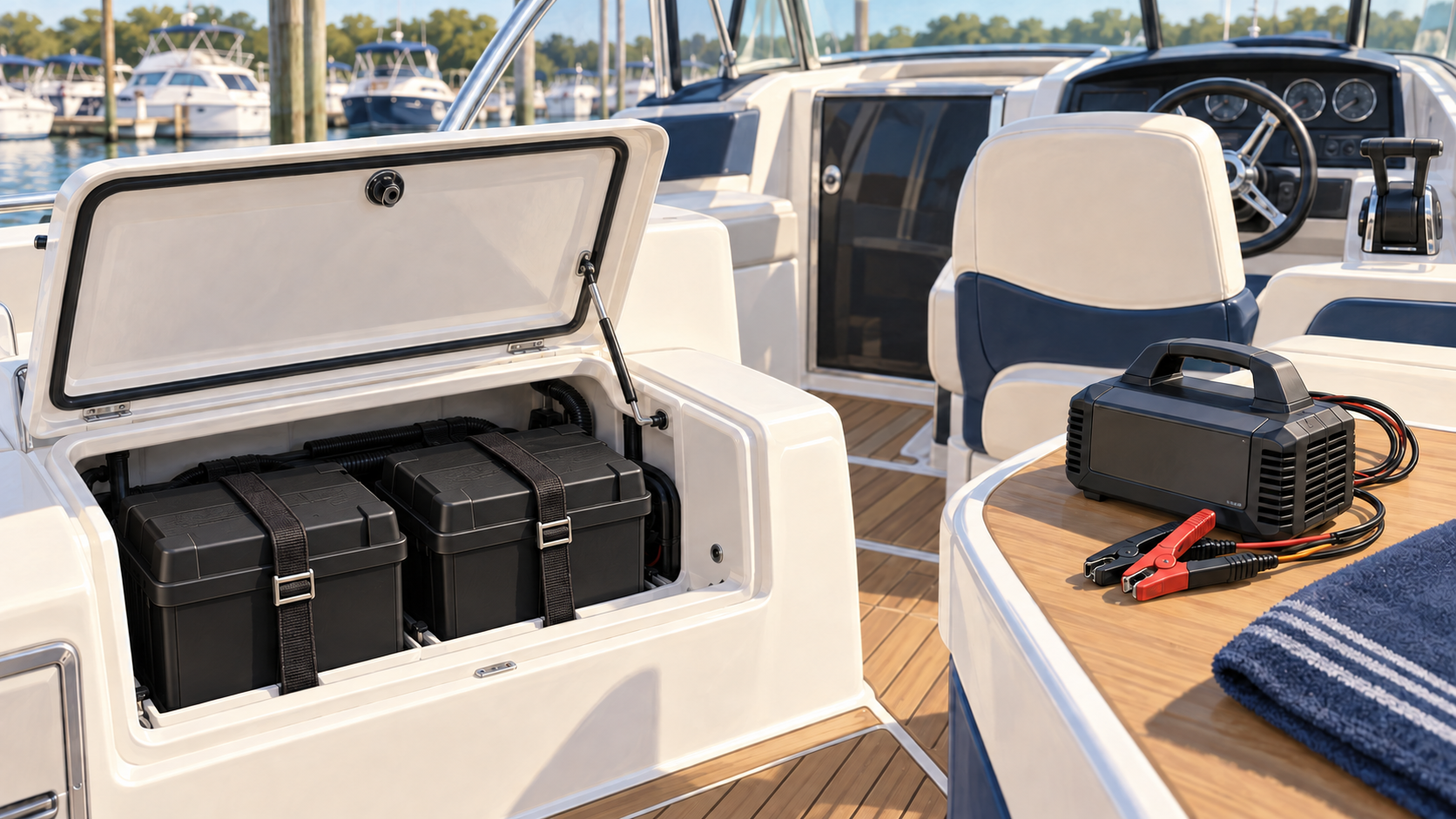
Featured image: original AI-generated editorial illustration, not a model-specific product photograph or wiring diagram. Technical guidance reviewed September 20, 2026.
If the two-bank onboard setup fits your needs, compare the current GENPRO10X2 listing and specifications at West Marine before ordering. Do not buy more banks or charging current than your installation can use safely.