
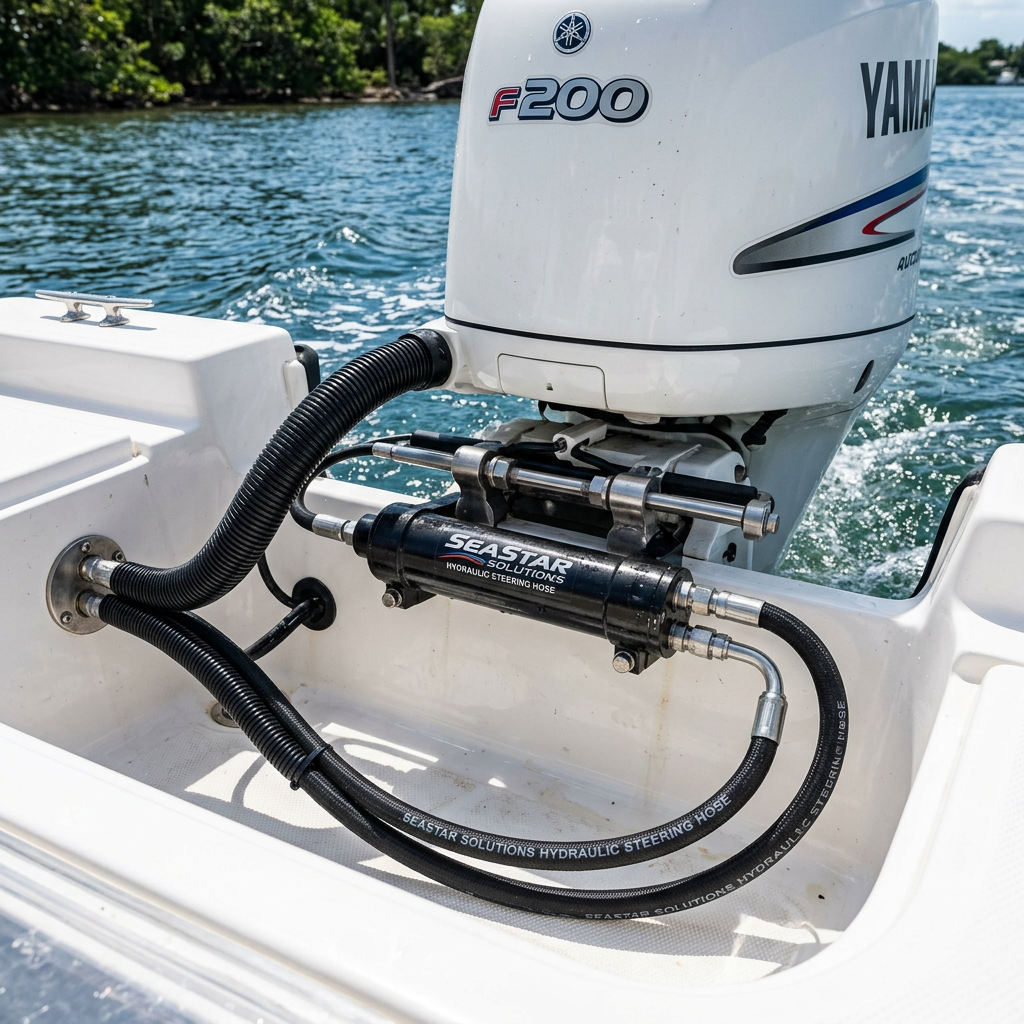
A healthy hydraulic outboard steering system may not hold the wheel spokes perfectly centered, and it can have a small amount of feel at the wheel. It should not have a noticeable dead zone. When you move the wheel deliberately, the cylinder and outboard should begin responding promptly and smoothly. If the wheel turns a meaningful amount before anything at the engine moves, treat that as a fault to locate—not a normal hydraulic-steering personality trait.
There is no universal “normal” number
Do not diagnose hydraulic steering by wheel degrees alone. Helm displacement, cylinder size, engine count, tie-bar arrangement, steering-wheel diameter, and power-assist or autopilot components all affect what you feel at the console.
Also, hydraulic steering does not mechanically lock the wheel to a straight-ahead engine position. A small amount of internal hydraulic slip or drift means the wheel may not remain centered after running. That is different from free play: rotation of the wheel with no prompt movement at the cylinder or outboard. SeaStar notes this inherent drift in hydraulic systems, while its outboard-cylinder guidance calls for mechanical play or slop anywhere in the system to be corrected. SeaStar steering catalog and maintenance guidance
What normal steering feels like
- The wheel turns smoothly in both directions without a soft, springy section.
- The cylinder rod begins moving as soon as the wheel is turned with steady pressure.
- The outboard reaches both steering stops without skipping, binding, or a sudden change in effort.
- The cylinder body, support rod, tiller connection, and engine steering arm stay firmly located while the system works.
- There is no fresh hydraulic fluid at the helm, hoses, fittings, cylinder end caps, or around the cylinder rod.
A little movement caused by normal clearances in an engine bracket or linkage can exist, especially on an older installation. But it should be small, repeatable, and visible at the connection—not a vague quarter-turn of wheel movement that disappears into the system.
The dockside test: find where the motion is going
This is a two-person job. Keep the engine off, place the boat securely on the trailer or in a calm slip, and make sure nobody puts hands near pinch points around the steering cylinder, tilt tube, or engine bracket.
- Trim the engine to its normal running position. A fully tilted outboard can change cylinder geometry and can hide or exaggerate a symptom.
- Center the engine approximately. Put a small piece of tape at the top of the steering wheel as a reference.
- Have one person gently rock the wheel port and starboard. Use only the amount of movement that feels like the suspected play. Do not force it against a steering stop.
- Have the observer watch the system in order: wheel and helm mounting, helm hose fittings, hoses, cylinder body and support hardware, cylinder rod, tiller bolt or steering arm connection, then the outboard itself.
- Note the first part that moves. The component moving before the engine responds is usually where the clearance or hydraulic problem is showing itself.
Clean any oily areas first with a suitable cleaner and a rag. Then repeat the test. A fresh wet line at a fitting or seal tells you much more than old grime.
What the symptom usually points to
Soft, springy play: likely air in the hydraulic circuit
Hydraulic fluid transmits steering force with very little compression. Air compresses. That is why air in the system often feels springy or spongy: the wheel moves, resistance builds gradually, and the engine seems to catch up rather than respond immediately.
- Steering feels worse after a leak, a hose replacement, recent steering work, or a low helm reservoir.
- The wheel may feel inconsistent from one direction to the other.
- The fluid level at the helm may rise and fall noticeably as the wheel is turned.
- The problem may improve briefly after bleeding, then return because the system is still drawing air through a leak.
Bleeding is the remedy only after checking fluid level and looking for the reason air entered the system. Dometic’s SeaStar guidance warns that incomplete purging leaves steering spongy and unresponsive, and that allowing the fluid level to disappear during the process can introduce more air. Follow the bleeding procedure for the exact helm, cylinder, power-assist, and autopilot arrangement aboard your boat. Dometic SeaStar filling and purging instructions
Visible movement at a bracket, support rod, or steering arm: loose hardware or worn bushings
If the cylinder rod moves but the outboard does not immediately follow, watch the mechanical connections closely. Slop can come from a loose tiller bolt, worn pivot hardware or bushings, a loose cylinder support arrangement, or hardware installed without the specified spacers, washers, locking method, or torque.
This is not a “give it another turn with a wrench” repair. Outboard steering hardware carries high reversing loads, especially when the boat lands in a chop or the prop is producing steering torque. Use the steering manufacturer’s installation drawing and the outboard maker’s rigging information for the exact hardware stack and torque values. Do not substitute a generic bolt for a specified steering fastener. SeaStar’s outboard-cylinder instructions specifically require removal of support-rod free play during installation and specify the steering-arm connection hardware and torque. SeaStar outboard-cylinder installation instructions
Fluid at the cylinder, helm, or fittings: leaking seal or connection
Hydraulic fluid on the cylinder rod, end caps, helm shaft, hose fittings, or inside the splashwell is a repair item, not a cosmetic nuisance. A leak lowers the fluid reserve and can admit air. It can turn modest play into weak or delayed steering, often at the least convenient time.
Look especially at:
- Both cylinder bleed fittings and hose fittings
- The cylinder rod and its seals
- Cylinder end caps
- The helm shaft area behind the steering wheel
- Hose runs where they rub, kink, chafe, or pass through rigging boots
Do not put a finger over a suspected pressurized leak. Wipe it clean, operate the steering gently, and inspect for fresh fluid with the engine off.
No external leak, but the engine will not hold position: possible internal bypass
A helm pump or cylinder can wear internally without leaving a puddle. Internal leakage lets fluid bypass a seal or valve instead of holding pressure where it belongs. Symptoms may include an engine that slowly changes angle under load, a wheel that keeps moving after the engine has reached a stop, or steering that was properly bled but still feels delayed or will not hold.
That diagnosis needs more than a guess at the dock. An autopilot pump, power-assist unit, wrong fluid, contaminated check valves, or an incorrect bleed sequence can produce similar complaints. Have a qualified marine steering technician isolate and test the helm, cylinder, and any added components before replacing parts.
Do not confuse steering play with steering pull
A boat that pulls to one side while on plane may have a propeller-torque, engine-trim, or trim-tab issue even when the steering has little free play. Conversely, a loose steering connection may make a boat wander and amplify the workload of correcting that pull. First make sure the steering is mechanically secure, properly bled, and capable of full travel. Then evaluate handling at a conservative speed in open water.
When the boat should not be operated
Keep the boat at the dock, on the trailer, or limit movement strictly to getting it safely secured if any of the following applies:
- There is an active hydraulic-fluid leak, a low reservoir, or fluid spraying or weeping from a fitting or seal.
- The cylinder, support hardware, steering arm, tiller bolt, tie bar, or mounting bracket visibly shifts before the outboard moves.
- A fastener is missing, loose, corroded beyond confidence, damaged, or secured with an improvised substitute.
- The wheel turns through a substantial dead zone, suddenly loses resistance, skips, binds, or does not produce consistent engine movement.
- The engine cannot be moved smoothly from stop to stop, or the steering range is reduced or uncertain.
- The steering was recently bled but remains spongy, or the symptom is getting worse.
- The system includes power assist, an autopilot pump, multiple stations, multiple engines, or a tie-bar setup and the fault cannot be clearly identified.
Loss of steering is not a problem to troubleshoot on plane. A loose connection can progress from a little wandering at idle to no dependable directional control when wind, current, speed, or traffic raises the stakes.
A sensible repair order
- Identify the steering system and obtain the correct manufacturer manual.
- Inspect for leaks, chafe, missing hardware, corrosion, and visible mechanical motion.
- Verify the helm fluid level using the manufacturer’s instructions and approved fluid.
- Correct documented mechanical hardware issues with the specified parts, spacers, locking hardware, and torque.
- Bleed the complete system using the correct procedure for its exact layout.
- Recheck at the dock, then conduct a cautious sea trial only after steering response is firm, smooth, leak-free, and repeatable.
- If play remains, have the helm, cylinder, and any power-assist or autopilot components professionally isolated and tested.
Sources and further reading
- Dometic SeaStar manual filling and purging guidance
- SeaStar hydraulic outboard-cylinder installation instructions
- SeaStar steering maintenance and system overview