
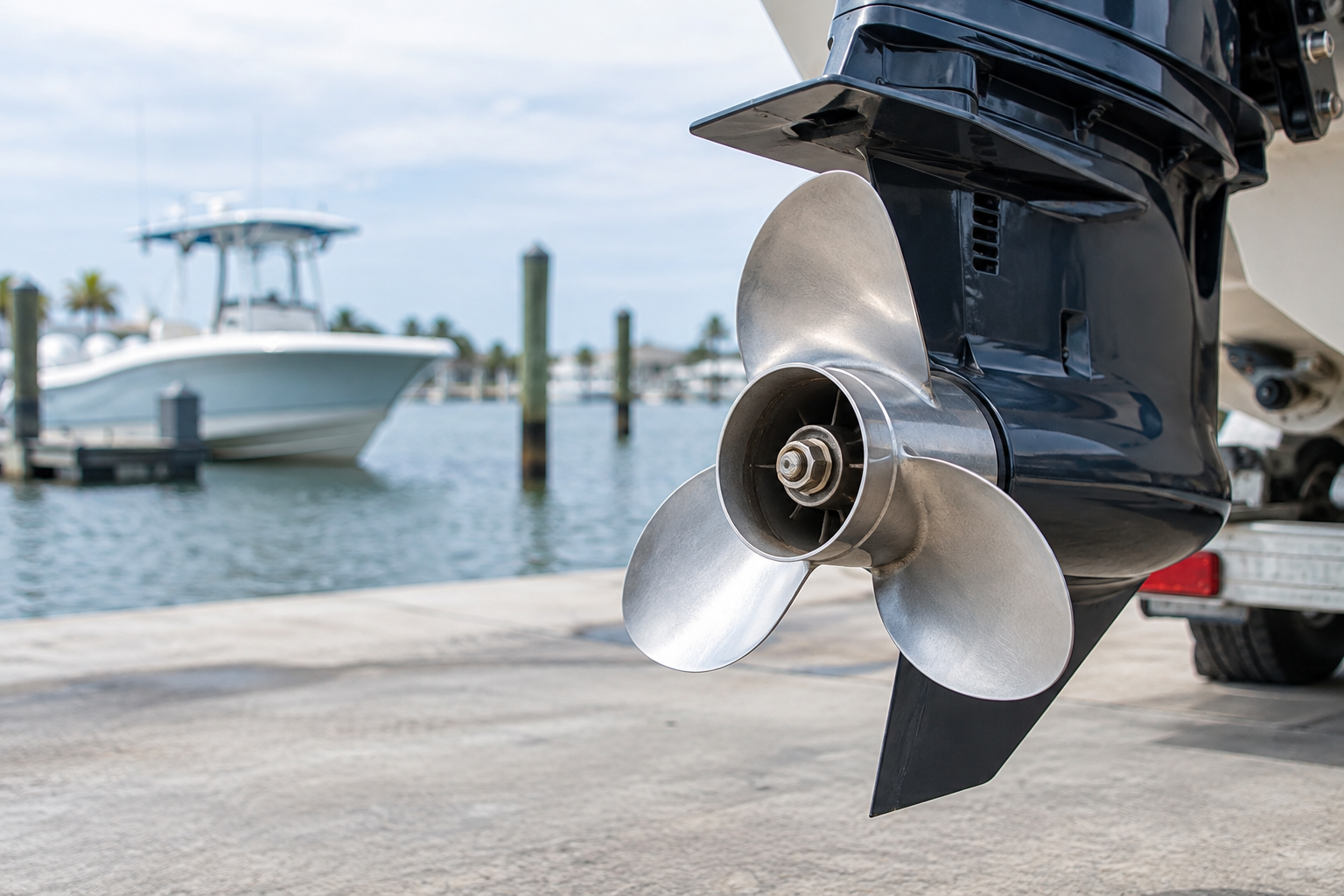
Short answer: Propeller pitch is the theoretical distance a prop would move forward in one revolution if it were turning through a solid. On the same propeller model, going up in pitch usually lowers wide-open-throttle (WOT) RPM and can slow acceleration. Going down in pitch usually raises WOT RPM and can improve hole shot and load carrying.
The correct pitch is not simply the one that produces the highest speed. It is the pitch that lets a healthy engine reach the manufacturer-specified WOT RPM range with the boat carrying its normal load—while still planing, turning, and trimming cleanly.
| What you observe | Likely direction | Check before changing |
|---|---|---|
| Engine exceeds its specified WOT RPM range | More pitch may reduce RPM | Tachometer accuracy, load, and the current propeller |
| Engine cannot reach the bottom of its WOT RPM range | Less pitch may raise RPM | Fuel, ignition, compression, hull growth, and excess load |
| Slow hole shot or difficulty planing with a heavy load | Less pitch may help | Blade design, diameter, engine height, and trim |
| RPM suddenly flares in turns or while trimming out | Do not choose pitch yet | Ventilation, mounting height, trim, and propeller damage |
What do propeller numbers such as 14 × 19 mean?
A prop stamped 14 × 19 is generally 14 inches in diameter and 19 inches in pitch. Diameter is the width of the circle made by the blade tips. Pitch is the theoretical distance the propeller would advance during one complete turn if it moved through a solid with no slip.
Water is not a solid, so a 19-pitch propeller does not actually move the boat exactly 19 inches every revolution. The difference between theoretical and actual travel is called propeller slip. Some slip is normal and necessary for a propeller to produce thrust. What matters is whether the propeller keeps a consistent bite and lets the engine operate in its intended RPM range.
What happens when you increase propeller pitch?
A higher-pitch prop takes a larger theoretical bite on each revolution. Think of it like selecting a taller gear on a bicycle: it may travel farther per turn, but it takes more effort to turn.
Within the same propeller family, increasing pitch usually:
- Lowers WOT engine RPM.
- Slows hole shot and acceleration.
- Makes it harder for a heavily loaded boat to climb onto plane.
- May increase top speed only if the engine has enough power to turn the propeller inside its approved WOT range.
Higher pitch does not automatically mean a faster boat. If the engine cannot pull the taller pitch, the boat can become slower, harder to plane, and unpleasant to operate. Running consistently below the specified WOT range can also lug the engine.
What happens when you decrease propeller pitch?
A lower-pitch prop is like a lower gear. It asks less work of the engine on each revolution, so the engine can usually accelerate more quickly and reach a higher RPM.
Within the same propeller family, decreasing pitch usually:
- Raises WOT engine RPM.
- Improves hole shot and acceleration.
- Helps a boat plane with passengers, fuel, fishing gear, or watersports loads.
- Can reduce maximum speed because the engine reaches its RPM limit sooner.
Too little pitch can let the engine exceed its specified WOT range. Do not rely on the rev limiter as a propeller-selection tool. If the boat over-revs, reduce throttle and correct the setup.
How much does one inch of pitch change RPM?
Some manufacturer literature uses roughly 150–200 RPM per inch of pitch as a starting estimate. That can be useful when comparing nearby pitches in the same propeller line, but it is not a universal conversion.
Diameter, blade count, blade area, cup, rake, material, hub design, gear ratio, hull, engine height, and load can all change the result. A 19-pitch three-blade aluminum propeller and a 19-pitch four-blade stainless propeller may load the same engine very differently. Treat the rule of thumb as an estimate, not a promise.
Start with the engine’s WOT RPM range
Find the WOT RPM range for your exact engine model and year in its owner’s manual or official specifications. Do not borrow a range from a similar-horsepower engine or an online discussion. Limits can differ by model, calibration, gearcase, and production year.
WOT is a setup test, not an instruction to run flat out all afternoon. In safe, open water, a brief properly conducted test tells you whether the engine is carrying the propeller load it was designed to carry.
Test the boat in the condition you actually use it. A lightly fueled, empty boat may reach the correct RPM while the same boat misses badly with four people, a full livewell, coolers, batteries, and fishing gear aboard.
Record a useful baseline
Before changing hardware, write down:
- Fuel level, passenger count, and normal gear.
- Water conditions, current, wind, air temperature, and elevation.
- Current propeller make, model, blade count, diameter, pitch, material, and hub system.
- Engine mounting-hole or jack-plate position.
- Maximum RPM, GPS speed, trim position, water pressure if available, and any loss of bite.
Make test runs in both directions when wind or current is meaningful. Bring the engine smoothly to full throttle, trim only until speed stops improving or the propeller begins to lose bite, and record the result. If the tachometer is questionable, verify it before buying a propeller.
When pitch is not the real problem
A propeller change cannot restore missing horsepower, repair a damaged propeller, or cure a bad setup. If the boat once reached the correct WOT RPM and no longer does, first ask what changed.
Check these items before blaming pitch:
- Active alarms, guardian mode, or a throttle that does not reach full open.
- Fuel restriction, stale fuel, dirty filters, poor tank venting, ignition trouble, or low compression.
- Bent blades, damaged edges, a slipping hub, fishing line behind the propeller, or incorrect prop hardware.
- Heavy bottom growth, hull damage, added batteries, waterlogged gear, or a much heavier normal load.
- Abnormal engine temperature, low cooling-water pressure, or other conditions that make WOT testing unsafe.
Stop the test for overheating, low water pressure, fuel leaks, steering faults, repeated alarms, or a propeller that repeatedly loses its bite.
Pitch versus outboard mounting height
Pitch and mounting height can both affect RPM, but they are not interchangeable adjustments.
Consider pitch first when the engine runs cleanly, holds cooling-water pressure, keeps its bite through normal turns and trim, and repeatedly reaches a steady WOT RPM that is simply above or below the manufacturer’s range.
Investigate mounting height or water flow first when RPM suddenly flares without a matching increase in speed, the propeller loses bite in ordinary turns or moderate chop, or the lower unit creates obviously excessive spray and drag.
Ventilation is not ordinary slip
Ventilation happens when air or exhaust reaches the propeller blades and the propeller suddenly loses grip. The usual clue is a sharp RPM increase without a matching increase in boat speed—often during acceleration, a turn, or trim-out. The answer may involve engine height, trim technique, cup, blade area, or propeller design. It is not automatically a pitch change.
A consistently low-mounted engine can add gearcase drag and heavy spray. An engine mounted too high may ventilate and, on some installations, compromise cooling-water pickup. Mounting-height changes should follow the boat and engine manufacturer’s guidance and may require a qualified outboard technician.
Blade count, diameter, cup, and material still matter
Pitch is only one part of a propeller. Diameter affects the blade-tip circle and the volume of water the propeller can work with. Blade area and blade count influence grip. Cup and rake affect load, lift, and how a propeller behaves near the surface. Stainless steel generally flexes less than aluminum.
That is why the cleanest test changes one meaningful variable at a time. If you move the outboard, change propeller families, alter vent plugs, and test with a different load on the same afternoon, the results will not tell you which change helped.
If you are also choosing blade count, read our guide to comparing three-blade versus four-blade propellers on the same boat.
A repeatable propeller-pitch test
- Confirm engine health and instrumentation. Resolve alarms, fuel-delivery problems, mechanical faults, and suspect tachometer readings first.
- Record the current setup. Note the exact propeller, engine height, normal load, WOT RPM, GPS speed, trim, water pressure, and handling.
- Rule out ventilation and obvious drag. A pitch change is meaningful only when the propeller receives clean water and the engine is mounted sensibly.
- Choose the direction. If the healthy engine cannot reach the bottom of its WOT range, less pitch may reduce load. If it exceeds the range, more pitch may add load.
- Change one variable. Stay within a propeller series and manufacturer-approved fitment when possible.
- Retest under comparable conditions. Compare RPM, GPS speed, hole shot, cruise behavior, turning grip, and cooling-water pressure—not top speed alone.
Propeller shops and dealers often have experience with specific hull-and-engine combinations, and some offer test programs. Bring them real baseline data. “It feels slow” is difficult to diagnose; exact RPM, load, propeller markings, speed, and symptoms are useful.
Common examples
The engine is 400 RPM below its minimum WOT range
Do not immediately assume that two inches less pitch will solve it. First confirm engine health, the tachometer, propeller condition, hull condition, and load. If the setup is healthy and consistent, a lower-pitch propeller in the same family may move RPM in the correct direction. Test to verify.
The boat is fine with two people but struggles with six
A lower-pitch or load-oriented propeller may improve acceleration and planing with the heavy load. Prop for the way the boat is genuinely used, not for the best speed obtained on a nearly empty test run.
RPM jumps in a turn but speed does not
That sounds more like ventilation than a basic pitch mismatch. Inspect trim, engine height, propeller condition, and whether the propeller is receiving aerated water. A propeller with different cup or blade area may help, but diagnose the water-flow problem first.
A higher-pitch propeller did not add speed
The engine may not have enough power to pull it, or the new propeller may differ in more than pitch. Compare WOT RPM and all design variables. The fastest propeller is often the one that lets the engine make its intended power—not the one with the largest pitch number.
The practical rule
Go up in pitch only when a healthy, stable setup is turning too much WOT RPM. Go down in pitch only when a healthy, stable setup cannot reach enough WOT RPM or needs better acceleration under its normal load. If RPM flares, performance changed suddenly, or the engine shows alarms or cooling issues, diagnose the underlying problem before selecting a propeller.
Once pitch is correct, blade design can fine-tune grip, lift, handling, and efficiency. If a propeller change also produces a persistent running list, use our guide to diagnosing a boat that leans to one side on plane. When the propeller is removed for inspection, it is also a good opportunity to locate and check the nearby protection points described in our boat-zinc and sacrificial-anode guide.