
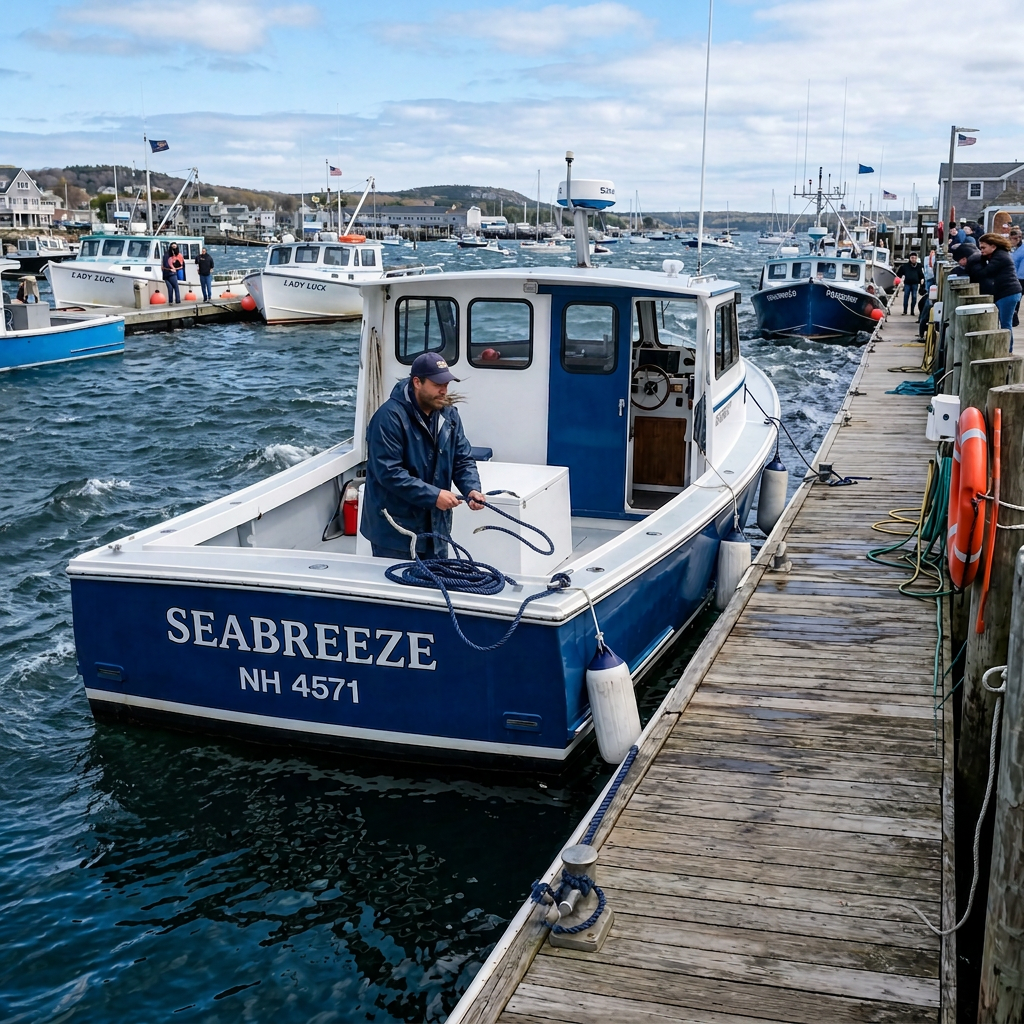
When wind or current pushes your boat along the dock, secure the diagonal spring line that opposes that movement. If the boat is sliding forward, lead a line from the bow or forward boat cleat to a dock cleat behind. If it is sliding aft, lead a line from the stern or aft boat cleat to a dock cleat ahead. A spring line will not replace a controlled approach, but it can turn a tense docking into a manageable one.
| Boat movement along the dock | Line to rig first |
|---|---|
| Sliding forward | Bow → dock cleat behind |
| Sliding aft | Stern → dock cleat ahead |
| Moving too fast to secure either safely | Abort and make another approach |
What a spring line actually does
A spring line leads diagonally along the dock rather than straight out from the bow or stern. That diagonal lead controls the boat’s movement along the dock. Bow and stern lines mainly keep the boat from moving away from the dock; spring lines keep it from surging forward or aft.
- Bow spring, or aft-leading spring: runs from the bow or a forward boat cleat to a dock cleat behind the boat. It checks forward movement.
- Stern spring, or forward-leading spring: runs from the stern or an aft boat cleat to a dock cleat ahead of the boat. It checks aft movement.
Traditional shipboard terminology names a spring by the direction it leads along the dock, while recreational explanations sometimes use bow-spring and stern-spring shorthand. To remove that ambiguity, this guide always states both endpoints. The U.S. Naval Institute’s mooring-line explanation follows the direction-of-lead convention.
Which line should you use first?
Watch the boat during the last few seconds of the approach. Ignore the dockside commentary for a moment and answer one question: Which way is the boat trying to travel along the dock?
- Boat is being pushed forward: Lead the first spring from the bow or forward boat cleat to a dock cleat behind.
- Boat is being pushed aft: Lead the first spring from the stern or aft boat cleat to a dock cleat ahead.
- Boat is being pushed directly away from the dock: A spring may help establish a pivot point, but it is not a magic lasso. Set up for a controlled approach, have the line ready, and be willing to abort if nobody can safely secure it.
Current deserves at least as much attention as wind, especially in a tidal marina, river, or canal. The force that matters is the one moving the hull at the dock, not the breeze you noticed in the parking lot.

Affiliate disclosure: Brighter Boater may earn a commission from purchases through these links, at no additional cost to you.

Matched to this docking guide
Seafit 1/2″ × 25′ Premium Double-Braid Dock Line
A 25-foot line provides useful reach for spring-line duty on many recreational boats and is less likely to come up short when led diagonally along a dock.
- 1/2-inch diameter × 25-foot length
- Black double-braid construction
- Pre-spliced eye for quick attachment
Fit guidance: Verify line diameter and length for your boat’s displacement, cleats, dock geometry, expected loads, and chafe points. This is a practical example, not universal sizing.
View at West Marine
Availability and pricing can change.
Wind-on dock: let the dock help
A wind-on dock is one where the wind is pressing the boat toward the dock. It is usually the easier case, provided the boat is protected and you do not arrive with too much speed.
- Rig fenders before entering the fairway. Set them at the widest part of the hull and at the height where the boat will first contact the dock.
- Choose the first spring line. If the boat will be carried forward after contact, prepare the bow-to-cleat-behind spring. If it will be carried aft, prepare the stern-to-cleat-ahead spring.
- Approach at bare steerage speed. Come in shallow enough that the boat can settle against the fenders rather than striking the dock bow-first.
- Make the spring line fast. The crew should place or pass the line from aboard; nobody needs to jump ashore with a moving boat.
- Stop the fore-and-aft slide. Once the spring is holding the boat’s travel along the dock, add the bow and stern lines and adjust the final setup.
Fenders absorb minor contact; they do not hold the boat in place. A proper dock setup uses bow, stern, and spring lines to control movement, with fenders acting as protection between hull and dock. BoatUS dock-line guide.
Wind-off dock: use the spring as a controlled connection
A wind-off dock is one where wind or current is trying to peel the boat away. This is where a prepared spring line can be more useful than a rushed attempt to get a bow line ashore.
- Decide on a bail-out route first. Know where you will go if the boat does not settle close enough for the crew to safely pass or place the line.
- Prepare one long spring on the docking side. It must reach the intended dock cleat without being stretched tight before the boat is in position.
- Bring the boat alongside slowly and deliberately. Use enough momentum for steerage, but no more. Avoid arriving so fast that the spring becomes a sudden stopping line.
- Secure the spring that opposes the boat’s likely slide. For forward slide, lead from the bow to a dock cleat behind; for aft slide, lead from the stern to a dock cleat ahead.
- Use the secured line as a pivot and restraint. With the boat under control, the helm can make small, boat-specific adjustments to bring the hull alongside. The exact throttle and steering inputs vary substantially with prop walk, engine or drive type, hull shape, and current.
- Finish the mooring. Add bow and stern lines, then reset fender height and line tension once the boat has stopped moving.
The key is that the spring line is made fast before you ask it to do work. Do not expect a crewmember to hold a loaded line by hand while the boat, wind, and engine argue about it.
Practice the line geometry before you need it
Spring-line docking is easiest to learn at a quiet, open-face dock in light conditions. Before the approach, point to the intended boat cleat and dock cleat and say the plan out loud: “The boat may slide forward, so lead the first spring from the bow to the cleat behind.” That gives the helm and crew the same picture before there is engine noise, wind, and an audience.

Keep the line coiled, free of knots, and attached to the boat before arrival. Docking guidance from the BoatUS Foundation similarly emphasizes preparation, steerage speed, and using lines as controlled fulcrums rather than trying to muscle the boat into place. BoatUS: Anchoring and mooring.
Common mistakes that make spring lines harder
- Using a short fender line as a spring line. A spring must reach a cleat well ahead of or behind the boat. Fender lines are usually too short and are not a substitute for proper dock lines.
- Securing a bow line first when the boat is sliding along the dock. It may keep the bow nearby while doing little to stop the stern from traveling.
- Trying to stop a fast-moving boat with a line. A loaded line can jerk a cleat, injure a crewmember, or pull the boat into the dock harder than intended.
- Wrapping a line around a hand or arm. Never do it. Let the line run if necessary and make another approach.
- Leaving the final mooring to fenders. Fenders cushion contact; correctly led and adjusted lines control the boat.
Know when to call it off
Abort the approach if the boat is moving too quickly, the crew cannot safely reach the cleat, a line is fouled, or wind/current has made the planned landing unrealistic. Back out to clear water, reset the fenders and lines, and make another approach. A second try is cheaper than a bent stanchion, crushed fingers, or a crew member in the water.
For a permanent slip, inspect spring lines regularly for chafe at chocks, pilings, and dock edges. Repeated movement under wind and wake can wear through a line long before it looks dramatically damaged from the cockpit. BoatUS Foundation’s dock-line guidance and its anchoring and mooring guide are useful follow-up references for practicing the maneuver and setting up a complete dock-line arrangement.
Spring-line questions new boaters ask
What is a spring line on a boat?
A spring line is a dock line led diagonally from the boat to the dock. Unlike a bow or stern line, it primarily limits the boat’s movement forward or aft along the dock.
What is a forward spring line?
Under the direction-of-lead convention, a forward spring leads from an aft part of the boat to a dock cleat ahead and checks aft movement. An aft-leading spring runs from a forward part of the boat to a dock cleat behind and checks forward movement. Because shorthand varies, identify the boat cleat and dock cleat instead of relying on the name alone.
Which spring line should go on first?
Rig the line that opposes the boat’s unwanted movement. For forward slide, lead from the bow or forward cleat to a dock cleat behind. For aft slide, lead from the stern or aft cleat to a dock cleat ahead. Keep hands and feet out of pinch points and never wrap a line around a hand.
New to boat ownership? Download the free two-page safety and equipment checklist and see the four guides to read before your first trip.