
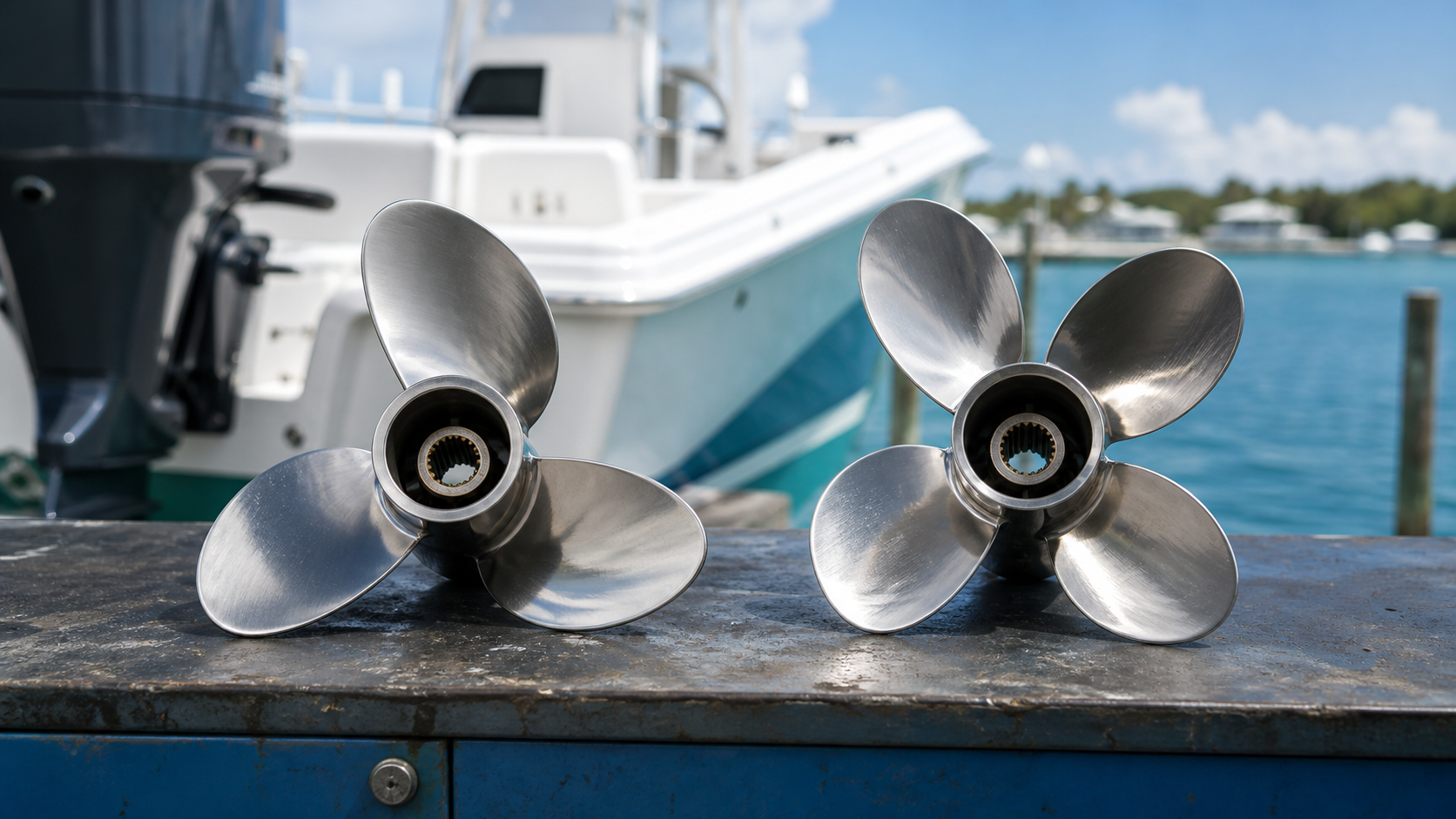
About this comparison: This is a manufacturer-informed explanation and a same-boat test protocol, not results from a Brighter Boater sea trial.
A three-blade prop is often the sensible speed-oriented baseline; a four-blade is often worth testing when the boat is slow to plane, ventilates in turns or chop, carries a heavy real-world load, or falls off plane too easily. The useful answer is not “which blade count wins?” but “which prop makes this hull, engine, load, and water use work better while keeping wide-open-throttle RPM in the engine maker’s specified range?”
What usually changes when you add a fourth blade
Blade count changes both the amount of blade area working in the water and the drag the propeller creates. More blade area can give the prop better grip—often called bite—when the boat is accelerating, turning, trimmed out, or running through aerated water behind a steep chop. But that extra blade can also add drag at the top end.
That is why the common pattern is a three-blade prop with a slight top-speed advantage and a four-blade prop with stronger acceleration, low-speed planing, and midrange control. Mercury describes the same general tradeoff, while also noting that a four-blade can avoid a speed loss on certain heavy or load-sensitive hulls because its added blade area helps the boat carry itself on plane more efficiently. Mercury Marine’s blade-count overview
| What to compare | Three-blade tendency | Four-blade tendency |
|---|---|---|
| Hole shot and time to plane | Can be very good on a light, clean-running hull | Often stronger, especially with passengers, fuel, bait, or gear aboard |
| Holding plane at lower speed | May need a little more speed to stay over the hump | Often holds plane at a lower RPM and boat speed |
| Grip in turns, chop, or high trim | Can ventilate sooner on some setups | Often maintains bite better |
| WOT RPM | Usually higher when compared with a similar four-blade | Often lower because the engine sees more load |
| Cruise | May be efficient at a speed-oriented cruise point | May improve practical cruise on a heavier boat if it reduces slip and keeps the hull cleanly on plane |
| Top speed | Often has the advantage | Often gives up some speed, though not on every hull |
Do not compare blade count alone
Matching nominal pitch can help isolate differences, but it is not a requirement for choosing a safe replacement prop or proof of a controlled experiment. Diameter, blade area, rake, cup, barrel design, material, hub system, and blade thickness all affect how hard the prop loads the engine and how the boat rides. A 19-inch three-blade from one family can behave very differently from a 19-inch four-blade from another.
For the cleanest comparison, use props that fit the same gearcase and are as closely matched as practical in manufacturer family, material, nominal pitch, diameter, and intended application. Then record every stamped or published specification. If the four-blade is only available in a different pitch, that can still be a useful owner test—but call it a setup comparison, not proof that blade count caused every difference.
Pitch is the propeller’s theoretical forward travel per revolution. All else equal, more pitch loads the engine more and reduces WOT RPM; less pitch does the opposite. Mercury Marine’s diameter-and-pitch guide explains that relationship, but cup and blade geometry can move the result enough that the tachometer and GPS—not the pitch stamp—settle the argument.
If you are still deciding whether pitch, engine height, or WOT RPM is the first variable to address, start with our propeller pitch, outboard height, and WOT RPM guide.
The same-boat test protocol
Propeller testing gets noisy quickly. A half tank versus a full tank, two passengers moving aft, a fresh breeze, or a few weeks of bottom growth can create a bigger difference than the propeller change. Test both props on the same day if possible, in the same water, with the same crew, gear, fuel level, engine mounting height, and trim-tab setting.
Before leaving the dock
- Inspect both props for bent edges, fishing line behind the thrust washer, cracked hubs, or blade damage.
- Confirm the tachometer is credible and GPS speed is available.
- Record engine model, gear ratio if known, engine mounting height, hull condition, water type, fuel aboard, passenger count, and test load.
- Check the operator’s manual for the engine’s WOT RPM range. The final prop must allow the engine to operate inside that range under a normal load, preferably near the upper part of that range when the manufacturer directs it. Mercury’s 150 FourStroke owner manual, for example, instructs owners to select a prop that keeps the engine within its specified full-throttle range under normal load and notes that a change from three to four blades commonly reduces WOT RPM.
Run each prop the same way
- Warm the engine fully and make a normal acceleration run from idle to plane. Time the run to a chosen speed, such as 20 mph or 30 mph, rather than relying only on the feeling of a “better hole shot.” Repeat at least three times.
- Note the minimum RPM and speed that will hold the boat on plane without porpoising or repeatedly dropping off plane.
- At several repeatable cruise points—such as 3,500, 4,000, and 4,500 RPM—record GPS speed, fuel flow if the instrument is trustworthy, trim position, and handling notes.
- Make WOT runs in opposite directions over the same stretch. Let the boat settle, trim for best safe speed, and average the results to reduce wind and current bias.
- Make several safe, moderate turns at a comparable speed. Watch for ventilation: a sudden RPM flare without a matching increase in boat speed. Do not turn this into a stunt; the point is to observe usable grip, not discover the boat’s bad manners at the limit.
Publish the assumptions with the result
A useful prop report includes more than a top-speed screenshot. Use a simple table and include the conditions that let another owner judge whether the result might transfer to a similar boat.
| Record | Three-blade | Four-blade |
|---|---|---|
| Brand/family, material, diameter, pitch, and hub | Record exact specification | Record exact specification |
| Fuel, people, gear, water, wind, and hull condition | Same test load and conditions | Same test load and conditions |
| Average time to target speed | Average of repeated runs | Average of repeated runs |
| Lowest stable planing speed and RPM | Measured result | Measured result |
| Cruise speed, fuel flow, and economy at set RPM | Measured result | Measured result |
| WOT RPM and two-way average GPS speed | Measured result | Measured result |
| Trim, steering effort, porpoising, and ventilation notes | Observed behavior | Observed behavior |
How to interpret the results
If the three-blade is faster at WOT, reaches the correct RPM range, and still planes and turns well with the load you normally carry, it may be the right everyday prop. That is especially likely on a lighter boat used mostly in calm water.
If the four-blade gets the boat on plane sooner, stays there at a lower speed, holds in turns, and makes the ride more manageable in chop or with a full fishing load, a small top-speed penalty may be money well spent. A boat that can stay on plane at a comfortable rough-water speed is often more useful than one that wins a calm-water speed contest by 1 mph.
Be careful with the phrase “more efficient at cruise.” Compare fuel burn at the same boat speed as well as at the same RPM. A four-blade may show a different RPM for a given speed because it changes prop slip, hull attitude, and engine load. The better result is the one that delivers the speed and ride you actually use with lower fuel burn, not simply the one that looks best at a single tachometer number.
A propeller change can alter running attitude, but a persistent list can have other causes. If the boat still runs unevenly after a controlled test, use our guide to diagnosing a boat that leans to one side on plane.
Keep the engine-safe result separate from the performance result
A prop that feels terrific in the midrange but pulls WOT RPM below the manufacturer’s operating range is not a finished answer. Likewise, a prop that lets the engine exceed that range under normal load is not acceptable just because the boat jumps on plane. Verify WOT after any meaningful change in blade count, pitch, engine height, carried load, or operating elevation.
Stop the comparison and investigate before running more test passes if the engine overheats, alarms, loses water pressure, develops unusual vibration, has a steering problem, or shows a sudden unexplained RPM flare. Propeller testing involves repeated high-speed runs; use open water, keep everyone seated and clear of the stern, wear the engine cut-off lanyard where applicable, and leave room to reduce power rather than trying to salvage a bad run.