
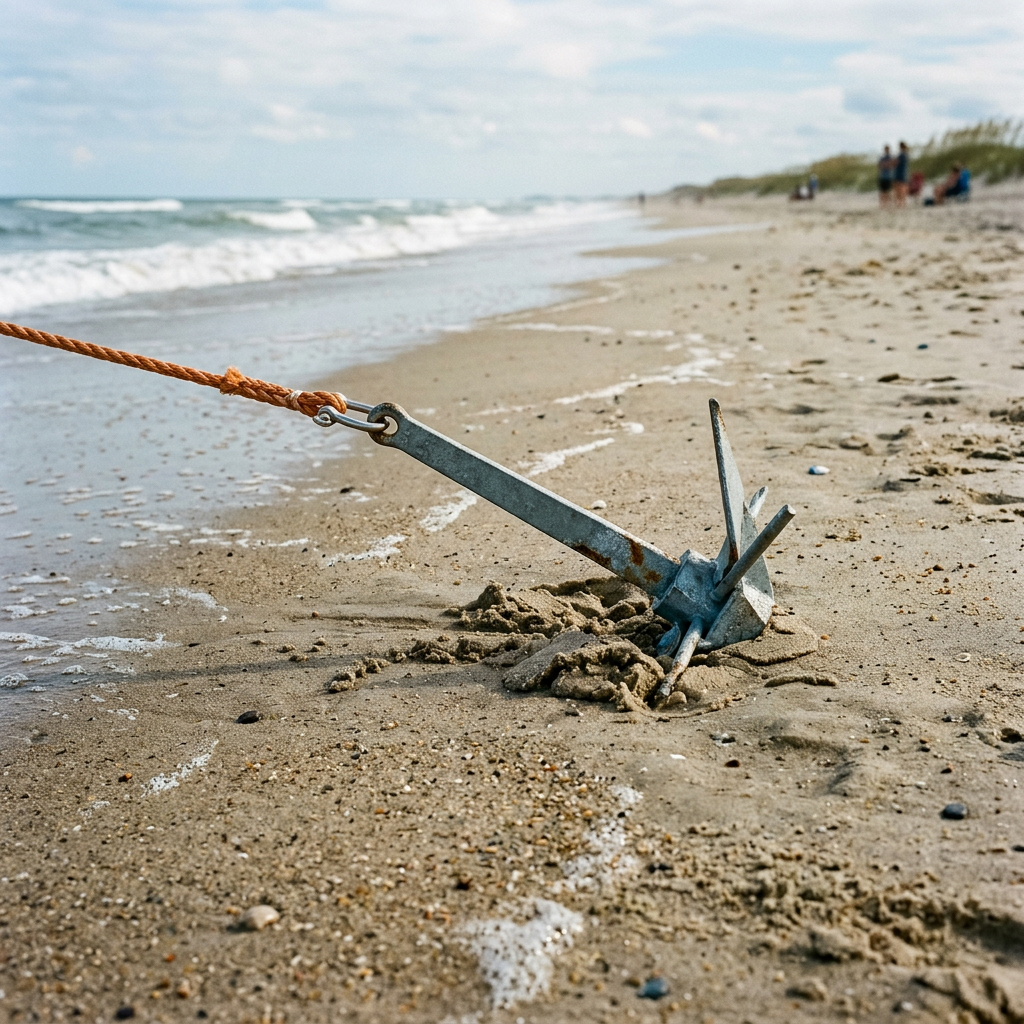
Boater Lab verdict: There is no single boat anchor that wins every bottom condition. Across several real-world test programs, modern scoop anchors are the most consistent general-purpose performers in sand and mixed bottoms, while large pivoting-fluke anchors are unusually efficient in deep soft mud. Traditional plow and claw designs can still work, especially when generously sized, but their setting and holding performance varies more from test to test.
The most important finding is not a brand name. It is that anchor design, bottom composition, scope, rode, weight, and setting technique work as a system. A strong anchor in the wrong bottom—or a good anchor deployed at short scope—can be a poor anchor.
Anchor styles compared
The product photos below are real West Marine catalog images. The links are affiliate links, which may earn Brighter Boater a commission at no added cost to you. Prices and availability can change; use the manufacturer’s sizing chart for your boat.


Where the Delta fits: The Lewmar Delta shown first is the fixed-plow design in this comparison. It is a distinct category from the hinged CQR, modern scoop anchors, pivoting-fluke anchors, and claw anchors.
| Anchor style | Common examples | Where tests show strength | Typical weakness |
|---|---|---|---|
| Modern concave scoop | Rocna, Manson Supreme, Mantus-style roll-bar anchors | Fast setting and high straight-line holding in firm sand; usually good resetting | Can be slowed by very soft mud, dense grass, or a fouled roll bar |
| Ballasted scoop | Spade and similar weighted-tip designs | Repeatedly strong in sand and mixed sand/mud tests; no roll bar to collect debris | Price, fit on some bow rollers, and model-to-model construction differences |
| Pivoting fluke | Danforth, Fortress | Exceptional holding per pound in sand and especially deep soft mud when the fluke angle is right | Poor penetration in grass, awkward resetting after a large direction change, and possible planing if deployed badly |
| Fixed plow | Lewmar Delta | Reliable, uncomplicated generalist; set well in some mud tests | Usually lower peak holding per pound than leading modern scoops |
| Hinged plow | CQR | Can hold well once deeply buried; decades of real-world history | Inconsistent initial setting, especially when tested at the same weight as newer designs |
| Claw | Bruce, Claw and copies | Simple handling and often predictable behavior when generously sized | Lower holding per pound and weak penetration in some hard-sand tests; copies vary widely |
| Hooking or deadweight | Fisherman, grapnel, mushroom | Specialized use in rock, weed, small craft, or permanent moorings | Not a general-purpose primary anchor for a cruising boat |
What the major test programs actually found
Practical Sailor: the winner changed with the test
Practical Sailor spent several years testing roughly two dozen anchors rather than declaring a winner from one pull. In its published summary, the top sand-setting anchors were Bulwagga, Spade, and Bruce. In a separate sand holding-power test, Spade, Bulwagga, and CQR led. In mud, Delta ranked first for setting, while Barnacle, CQR, and Bulwagga led the measured holding result. Combining its sand and mud holding tests put Spade, Bulwagga, and CQR at the top.
That looks contradictory only if “best” is treated as one attribute. Setting quickly, reaching a high straight pull, holding after the pull stops, and resetting after the direction reverses are different jobs. In a separate reset test with the pull direction changed about 140 degrees, roughly one-third of the anchors stayed buried, another third reset after moving, and two never reset. That is a reminder that a tide reversal can matter as much as a straight-line number.
Yachting Monthly / SAIL / West Marine: new-generation designs dominated hard sand
The 2006 California test compared 14 anchors recommended for 35- to 40-foot boats. Each was pulled at least three times at 5:1 scope, using a load cell that recorded several readings per second. The main bottom was hard, clay-like sand, with additional pulls at two other locations and selected 3:1, 7:1, and veering trials.
Modern scoop designs were the clear standouts. Rocna, Spade, and Manson Supreme were among the strongest and most consistent performers, while the traditional Claw and CQR struggled to penetrate the hard test bottom. The 38-pound Claw briefly peaked at 886 pounds before breaking out. The 35-pound CQR failed to set in the first location even at 7:1, then reached about 2,000 pounds at a second location before releasing. That is evidence about those anchors in those bottoms—not proof that every Claw or CQR will fail everywhere.
The same program also showed why single-location rankings are dangerous. An Oceane failed to set at two locations but reached the test boat’s 5,000-pound limit in multiple pulls at another. Small changes in bottom composition can reverse a result.
Chesapeake Bay: soft mud favored big flukes
A 2014 Chesapeake Bay program tested anchors from an 81-foot University of Maryland research vessel in very soft mud. The test was sponsored and published by Fortress, so its commercial interest must be disclosed. It nevertheless used a load cell, multiple pulls over four days, an outside marine-product tester, and included full pull traces for the competing anchors.
The broad result was unambiguous: large pivoting flukes produced the strongest soft-mud holding. A 21-pound Fortress FX-37 at its 45-degree mud setting exceeded 1,200 pounds and peaked around 2,000 pounds; the manufacturer reports that one recovery load approached 4,000 pounds before the test cable failed. Much heavier steel scoop and plow anchors generally did not penetrate the soft upper layer as deeply. This is a specialty-bottom result, not a universal endorsement: wide flukes that excel in mud can be poor choices in weeds or rock.
SV Panope: setting and resetting are visible, not inferred
Steve Goodwin’s SV Panope testing adds something most magazine pull tests lack: underwater video. His rig records bottom type, depth, scope, rode, pull force, and 180-degree reversals. Across many tests, the strongest modern designs tend to bury promptly and recover after a veer, while weaker performers may skate, lie on their side, or travel a long distance before resetting.
Panope’s work is especially useful for understanding failure modes, but it is not a universal laboratory standard. His boat’s available pull, the local seabeds, specific anchor sizes, and individual specimens limit direct comparisons with other programs. The method helps explain why results differ; it should not be reduced to one permanent league table.
Holding characteristics by bottom condition
| Bottom | Best-supported choices | Why they work | Main cautions |
|---|---|---|---|
| Firm sand | Modern scoop, ballasted scoop, large pivoting fluke | Sharp entry and broad buried area create high resistance | Hard-packed sand can expose poor tip geometry; confirm the set under power |
| Soft mud | Large pivoting fluke at the maker’s mud angle; oversized scoop as a secondary option | Wide flukes reach deeper, denser material and mobilize a large soil mass | Let the anchor settle, increase load gradually, and expect a longer set distance |
| Firm mud or clay | Sharp modern scoop, ballasted scoop, fixed plow | Concentrated tip weight starts penetration; growing fluke area adds hold | A smooth, hard surface may make any anchor skate before it bites |
| Grass or weeds | Sharp, narrow-toed, heavily weighted designs; sometimes fisherman-style hooks | The priority is cutting through roots into soil below | Controlled comparative data is sparse. Broad flukes and roll bars can foul; verify burial when it can be done safely and apply a controlled, gradually increased reverse load |
| Gravel, shell, or cobble | No consistently proven winner; robust scoop or claw may find a pocket | Success depends on finding material that can trap or bury the anchor | Holding can be sudden and temporary; reset performance is unpredictable |
| Rock | Purpose-built fisherman or grapnel only when local practice supports it | Hooks may catch a fissure instead of burying | A snag is not a reliable set and may be impossible to retrieve. Use a mooring or choose another anchorage when possible |
Why anchor tests disagree
- Bottom labels are too broad. “Sand” can mean loose grains, shell-mixed sand, or a nearly clay-hard surface. “Mud” can be a thin soup over firm clay or dense cohesive silt.
- Equal weight is not equal geometry. A broad aluminum fluke can present far more area than a compact steel anchor of the same weight.
- Scope changes the pull angle. More scope keeps the load closer to horizontal, encouraging burial. Practical Sailor has shown that the same anchor can bite hard or merely slide when scope, chain leader, or bottom changes.
- Straight holding is only one behavior. Boats yaw, wind shifts, and tides reverse. An anchor that posts a large straight pull may still break out and fail to reset.
- Copies are not necessarily equivalent. Tip weight, fluke angle, steel thickness, edge sharpness, and balance affect whether an anchor lands correctly and penetrates.
- Scale matters. Older designs are often carried much heavier than modern recommendations. A same-weight comparison can understate how a large legacy anchor performs in real cruising use.
The practical two-anchor strategy
For most coastal powerboats and sailboats, the evidence supports a complementary pair rather than a mythical do-everything anchor:
- Primary: a properly sized or slightly oversized modern scoop suited to the bottom you use most often.
- Secondary: a large pivoting-fluke anchor for soft mud and sand, with its own compatible rode and shackles.
Size both for the boat’s displacement, windage, and intended conditions—not length alone. Make sure the anchor fits the bow roller, the chain matches the windlass gypsy, and every shackle has an adequate working-load limit. Our guide to anchor rode and chain sizing explains the rest of the system.
How to turn a test result into a safe anchoring decision
- Check the chart and local cruising guides for the actual bottom.
- Use the anchor maker’s sizing table as a minimum, then account for windage and exposure.
- Deploy enough rode for the total depth, including bow height and tide. More scope usually improves holding.
- Lower the anchor; do not throw it. Pay out rode while drifting or backing slowly.
- Build reverse power gradually until the rode stays aligned and fixed references stop moving.
- Set an anchor alarm and recheck after a wind or current shift.
Do not confuse a successful engine test with a storm guarantee. Reverse thrust is a useful verification step, but waves, yawing, gusts, and changing pull direction can create different loads. If the forecast exceeds your ground tackle, anchorage, or experience, move early.
What the evidence supports
Best generalist: a modern scoop, especially where firm sand is common.
Best soft-mud specialist: a large pivoting-fluke anchor configured for mud.
Best safety upgrade: adequate scope, a larger properly matched anchor, and a second design for the bottom your primary handles poorly.
What no test proves: that one brand will hold every boat in every bottom. The reliable system is a suitable anchor, correctly sized rode, enough scope, a verified set, and a skipper willing to reset or move.
Sources and test notes
- Practical Sailor: Anchor Reset Tests and prior sand/mud test summary
- Yachting Monthly / SAIL / West Marine: 2006 Ultimate Holding Power test
- Practical Sailor: scope, rode, and bottom-variable testing
- 48° North: description of SV Panope’s instrumented, underwater-video method
- Fortress-sponsored Chesapeake Bay soft-mud test data
- West Marine: synthesis of scope, sizing, and two-anchor findings
Editorial disclosure: The Chesapeake Bay test was sponsored and published by Fortress, and West Marine is a retailer. We use those sources for their disclosed procedures and test data, compare them with independent publications, and do not treat manufacturer or retailer claims as neutral. Product links in this article are affiliate links. Brighter Boater may earn a commission from qualifying purchases at no added cost to the reader; affiliate relationships do not change the test findings or editorial conclusions.