
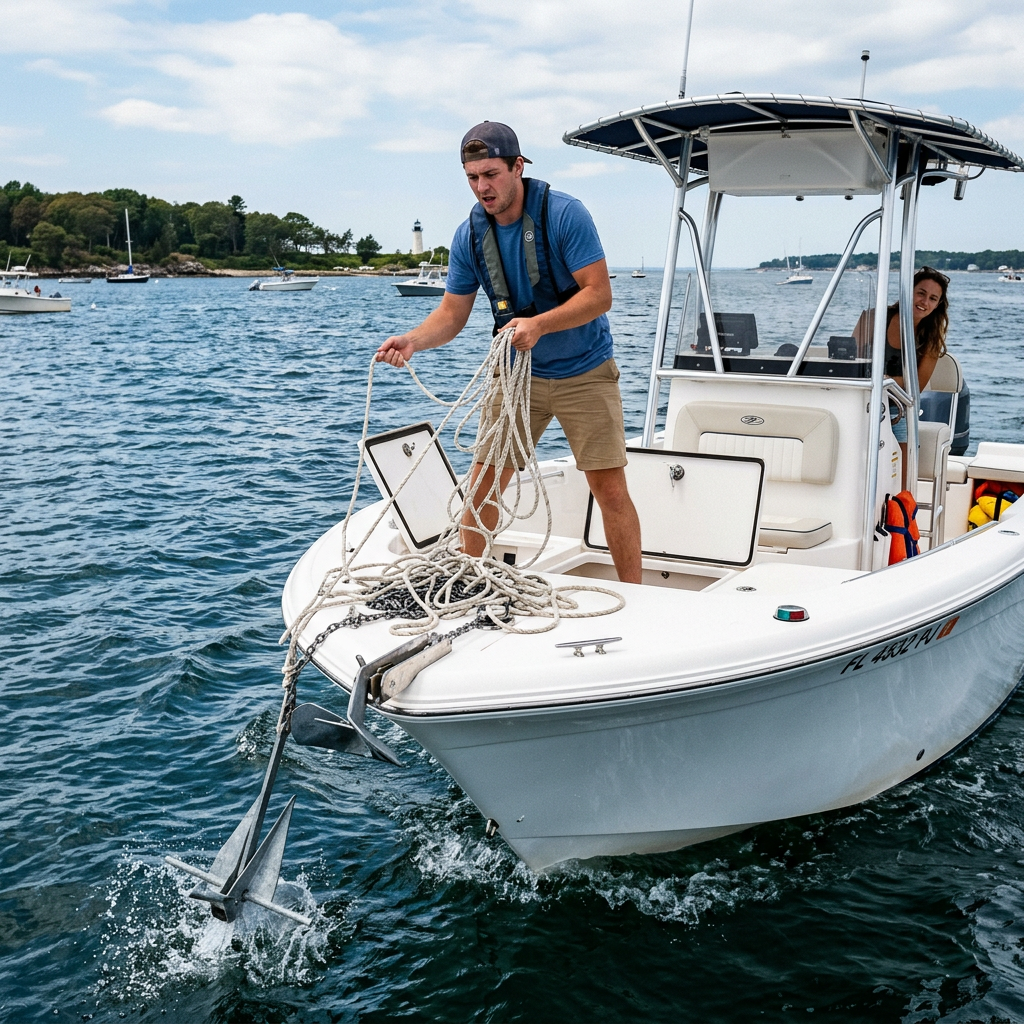
Setting an anchor is not a matter of throwing it overboard and hoping it catches. A reliable set comes from choosing the right spot, approaching it under control, lowering the anchor carefully, paying out enough rode, and testing the hold before you shut down and relax.
The short version: approach the drop point into the stronger of the wind or current, stop the boat, lower the anchor from the bow, drift or idle backward while paying out the planned rode, secure the rode, and gradually apply reverse power. Then verify that the boat has stopped moving over the bottom.
Before you begin: inspect the anchoring system
Your anchor system includes the anchor, shackles, chain, rope, bow roller or chock, cleat, and any windlass or snubber. A weak fitting can undermine an otherwise suitable anchor, so check the entire load path before leaving the dock.
- Confirm the anchor is appropriate for the boat, expected conditions, and bottom type.
- Inspect the rode for cuts, chafe, stiffness, corrosion, damaged splices, and badly rusted chain.
- Make sure shackles are correctly sized, fully tightened, and secured according to the manufacturer’s instructions.
- Verify that the bow cleat or other attachment point is intended to carry anchoring loads.
- Flake or arrange the rode so it can run without knots or tangles.
- Keep feet, hands, clothing, and loose gear out of the rode’s path.
If you need help sizing rope and chain, see How Much Anchor Line and Chain Does a Recreational Boat Need?.
Useful anchoring-system components
- Pre-spliced nylon anchor line — choose diameter and length from the boat’s displacement, windage, anchoring depth, and conditions.
- Galvanized anchor chain — match chain size and grade to the windlass gypsy, shackles, anchor, and working-load requirements.
For anchor-style choices, see our guide comparing anchor styles and published tests: which boat anchor holds best in sand, mud, grass, and rock.
Compatibility matters: these are component types, not universal size recommendations. Confirm every component against the boat and equipment manufacturers’ specifications before ordering.
Choose a safe place to anchor
Start with the chart, current conditions, and the forecast. Look for adequate depth, a bottom your anchor can hold in, room to swing, and protection from the expected wind and waves. Avoid channels, marked cable or pipeline areas, navigation aids, restricted zones, underwater obstructions, and places where the boat could swing into shoal water or another vessel.
Account for the full time you expect to remain anchored. Water level, wind direction, current direction, traffic, and weather may change. NOAA cautions that high or low tide does not automatically occur at slack current; tide and current predictions are separate and location-specific. Check both when current matters.
Estimate a swing circle using your planned rode length plus the boat’s length. Nearby boats may have different rode lengths, anchor types, or windage, so do not assume every boat will swing in exactly the same arc.
Calculate how much rode to use
Scope is the ratio of rode length to the vertical distance from the bottom to the point where the rode leaves the boat. That vertical distance includes water depth and the height of the bow roller or chock above the water.
The U.S. Coast Guard’s recreational-boating guide gives a general range of five to seven times that total vertical distance. Conditions, anchor design, bottom type, available space, waves, wind, and the anchor manufacturer’s instructions can require a different plan.
For example, if the greatest expected depth during your stay is 12 feet and the bow roller is 3 feet above the water, the vertical distance is 15 feet. A 7:1 scope would require 105 feet of rode. Use the greatest expected depth, not merely the depth displayed when you arrive.
How to set the anchor step by step
- Brief the crew. Decide who controls the helm and who handles the anchor. Agree on simple hand signals before engine noise and distance make conversation difficult. Everyone working on the bow should wear a properly fitted life jacket.
- Approach the drop point slowly. Point the bow into the stronger of the wind or current and approach at idle speed. The drop point is normally upwind or up-current of where you want the boat to settle. Stop forward motion before lowering the anchor.
- Lower the anchor—do not throw it. Lower it under control until it reaches the bottom. Throwing can foul the rode around the anchor, damage the boat, or injure someone. Never wrap the rode around a hand, arm, or foot.
- Move backward while paying out rode. Let the boat drift back or use the engine gently in reverse. Feed rode at roughly the rate the boat moves so it lays out along the bottom instead of piling on the anchor. Pause or lightly snub the rode as appropriate to help the anchor orient, but avoid a hard load before it has begun to dig.
- Secure the planned scope. Once the calculated rode is out, secure it to the proper bow cleat or transfer the load to the boat’s designed anchoring point. Do not leave the holding load on a windlass unless its manufacturer expressly permits it. Use a snubber where the system calls for one.
- Set the anchor gradually. With the bow still aligned into the load, apply reverse power slowly. Increase the load in stages rather than immediately using heavy throttle. Anchor manufacturers emphasize that a slow build gives the anchor time to bury; sudden speed may cause it to skate or tumble.
- Verify the hold. Reduce power and watch the boat. Take bearings on at least two fixed objects that are well separated, or watch position and distance on a chartplotter. The boat may swing, but it should not keep moving downwind or down-current. Feel the rode carefully at a safe point: repeated jerking or vibration can indicate dragging, although a smooth rode alone does not prove a good set.
How do you know the anchor is really set?
A single GPS position is not enough because the boat naturally moves within its swing circle. Use several checks:
- Apply a controlled reverse load appropriate for the boat and conditions.
- Watch two shore bearings or charted objects for continuing movement.
- Set an anchor alarm with a radius that accounts for the boat’s expected swing, GPS error, and where the anchor actually lies.
- Wait and recheck before leaving the helm unattended.
- Confirm that the boat still has safe depth and clearance throughout the expected swing.
An anchor alarm is a backup, not a substitute for situational awareness or a proper watch. Recheck after a wind shift, current reversal, major tide change, squall, or noticeable increase in load.
What to do if the anchor drags
If the boat continues moving over the bottom, treat the set as failed. Start the engine, maintain control of the boat, retrieve the anchor, and try again with a better approach, more suitable location, more scope, or a different anchor for the bottom. Do not keep adding throttle to an anchor that is obviously skipping across the bottom.
Leave the anchorage if there is not enough room to reset safely or if the weather, traffic, bottom, or equipment exceeds your experience. If the boat is drifting toward danger, controlling the boat takes priority over saving the anchor or rode.
Never anchor a typical powerboat from the stern
The Coast Guard warns against stern anchoring because the transom may be vulnerable to following seas, wake, or current. Water can come aboard faster than the boat can recover, especially on small powerboats. Anchor from the boat’s designed bow attachment point unless the manufacturer provides a different procedure for a specialized system.
Lights, shapes, and restricted visibility
Anchored vessels are subject to the Navigation Rules. Rule 30 describes anchor lights and day shapes and includes exceptions based on vessel length and location. Rule 35 addresses sound signals in restricted visibility. Check the current federal rules, local requirements, and any special-anchorage provisions for your boat and location rather than assuming one exception applies everywhere.
How to retrieve the anchor safely
- Start the engine and brief the crew before releasing the rode from its holding point.
- Move slowly toward the anchor while retrieving slack. Use the engine to move the boat; do not use the windlass as a winch to pull the entire boat against wind or current.
- Keep the rode clear of the propeller and keep hands away from the windlass, bow roller, and loaded line.
- When the rode is nearly vertical, secure it and use the boat’s motion or the manufacturer’s recommended method to break the anchor free. Avoid aggressive power maneuvers.
- Wash off mud if practical, inspect the hardware, and secure the anchor so it cannot deploy or become a projectile underway.
Common anchoring mistakes
- Using water depth alone and forgetting bow height or the rising tide.
- Dropping the anchor before the boat has stopped moving forward.
- Piling the rode on top of the anchor.
- Using too little scope because the anchorage is crowded.
- Applying heavy reverse power before the anchor starts to dig.
- Assuming a chartplotter icon proves the boat is stationary.
- Leaving the holding load on equipment not designed to carry it.
- Anchoring from the stern.
- Failing to plan for a wind shift, current reversal, or tide change.
A simple practice session
Practice on a calm day in an uncrowded area with good holding ground and plenty of room. Set and retrieve the anchor several times at low load. Have each regular crew member practice the helm and bow roles. The goal is to make the procedure familiar before you need the anchor during an engine problem, worsening weather, or another stressful situation.
Sources and further reading
- U.S. Coast Guard: A Boater’s Guide to the Federal Requirements for Recreational Boats
- U.S. Coast Guard Navigation Center: International and Inland Navigation Rules
- NOAA Tides & Currents
- NOAA explanation of tides, tidal currents, and slack water
- Fortress Anchors: Safe Anchoring Guide
This article provides general recreational-boating information. Follow your boat and equipment manufacturers’ instructions, check current charts and local rules, and seek hands-on instruction when conditions or equipment are unfamiliar.