
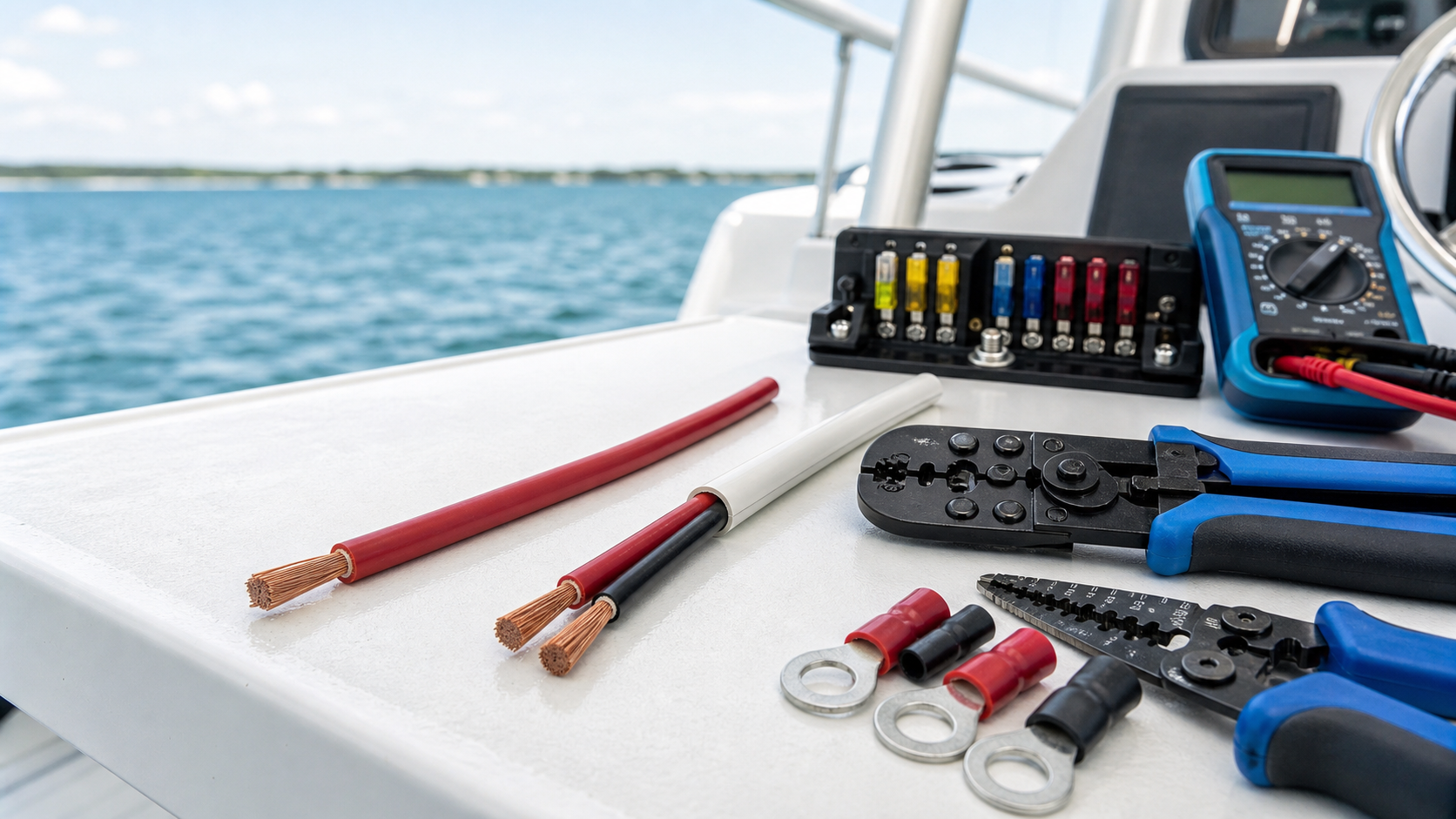
Choosing between marine primary wire and duplex wire is mostly a routing decision—not a shortcut around sizing the circuit correctly. Primary wire contains one insulated conductor. Duplex cable places a positive and negative conductor inside one protective outer jacket. Both can be appropriate on a 12- or 24-volt recreational boat when the cable is genuine marine-grade tinned copper, the gauge is sized for the load and round-trip length, and the circuit is properly protected.
Marine primary wire vs. duplex wire: the quick answer
| Use case | Usually the cleaner choice | Why |
|---|---|---|
| A short run inside an existing harness or conduit | Primary wire | One conductor is easier to route, replace or color-code individually. |
| A new two-wire branch circuit to a light, pump or accessory | Duplex wire | Positive and negative stay together inside an abrasion-resistant jacket. |
| Separate positive and negative routes | Primary wire | Each conductor can follow the correct physical path. |
| Exposed or difficult cable run | Duplex wire | The outer jacket adds organization and mechanical protection, but connections still need sealing. |
| Battery cables, starter cables or very high-current equipment | Application-specific cable | Follow the equipment maker and a qualified marine electrician; ordinary branch-circuit advice may not apply. |
What is marine primary wire?
Marine primary wire is a single flexible conductor with its own insulation. On a typical DC boat circuit, you may run a red primary conductor from the protected power source to the load and a yellow or black return conductor back to the negative bus. Individual conductors are useful when the positive and negative paths separate, when you are repairing one wire in an existing loom, or when a tight route makes a jacketed cable awkward.
The tradeoff is installation discipline: the wires must be supported, protected from chafe and labeled well enough that future owners can trace the circuit. Two loose conductors should not be allowed to wander independently through a bilge or console.
What is marine duplex wire?
Marine duplex wire contains two separately insulated conductors inside a shared outer jacket. It is often the tidy choice for a new branch circuit because the positive and return travel together. The jacket can add chafe protection and makes the run easier to secure and identify.
Duplex cable is not automatically waterproof. Moisture can still enter at cut ends or damaged insulation, and every termination remains a potential corrosion point. Support the cable, add chafe protection at pass-throughs, create drip loops where appropriate and seal terminations correctly.
The gauge matters more than the cable style
Do not choose wire size by looking only at the device’s amperage. DC voltage drop depends on current and the entire circuit length—the positive run to the load plus the negative return. A device 15 feet from the battery can create a 30-foot circuit.
Blue Sea Systems’ marine wire guidance uses a 3% voltage-drop target for critical circuits such as electronics, navigation lights, bilge blowers and panel feeders, and a 10% target for many non-critical loads. The U.S. Coast Guard Boatbuilder’s Handbook also publishes conductor requirements and ampacity guidance for regulated recreational-boat construction. For a retrofit, size the wire to satisfy both voltage drop and allowable ampacity, then use the larger conductor the calculations require.
Upsizing can reduce voltage drop, but an oversized conductor does not make an oversized fuse safe. Circuit protection must match the conductor, equipment and installation. If a run involves a battery bank, inverter, shore power, gasoline-engine space or other high-consequence work, use a qualified marine electrician.
How to identify wire worth putting on a boat
- Stranded copper: flexible construction tolerates vibration better than household solid wire.
- Tinned strands: tin plating helps resist corrosion in a marine environment.
- No CCA: copper-clad aluminum should not be substituted for properly sized marine copper cable.
- Clear gauge and temperature markings: vague cable with no traceable specifications is a red flag.
- Correct insulation: confirm the cable is rated for the temperature, voltage and environment where it will be installed.
Two practical 8-AWG examples
Affiliate disclosure: Brighter Boater may earn a commission from qualifying purchases at no added cost to you. These are examples, not universal size recommendations; calculate your circuit before ordering.
For a circuit that genuinely calls for 8 AWG, GEARit 8-AWG marine primary wire is the single-conductor option. If the positive and negative will follow the same route, GEARit 8/2-AWG marine duplex wire keeps both conductors inside one jacket. Buy neither simply because 8 AWG “looks heavy enough.” Confirm current draw, circuit length, voltage-drop target, insulation rating, engine-space exposure and protection requirements first.
A safe beginner workflow
- Read the equipment manufacturer’s current and fuse recommendations.
- Measure the complete positive-and-negative circuit length.
- Choose the correct voltage-drop target for the load.
- Check ampacity and environmental derating, not just voltage drop.
- Select primary or duplex construction based on routing and protection.
- Protect the positive conductor close to the power source as the applicable standard and equipment instructions require.
- Use a quality ratcheting crimper, correct terminals and adhesive-lined heat shrink where appropriate.
- Support the wire, protect every pass-through and label both ends.
- Test voltage at the load while it is operating, then inspect the connection after the first trips.
Common wiring mistakes to avoid
- Measuring only the one-way cable distance.
- Using automotive wire, household solid wire or unverified CCA cable.
- Assuming an outer jacket makes a connection waterproof.
- Hiding an undersized conductor behind a larger fuse.
- Using household wire nuts, loose twist connections or unsupported splices.
- Routing cable against sharp fiberglass edges or hot engine components.
- Reusing corroded terminals or crimping with pliers.
For a related trailer project, see our beginner guide to rewiring boat-trailer lights. If you are planning a new accessory circuit, also review our bilge-pump troubleshooting guide before changing wiring or protection.
Sources and further reading
- U.S. Coast Guard Boatbuilder’s Handbook: Electrical Systems
- Blue Sea Systems: Marine Wire Size and Ampacity
- Blue Sea Systems Circuit Wizard
This article is educational and U.S.-focused. Existing boats can contain manufacturer-specific wiring, and local inspection requirements may apply. When in doubt, use an ABYC-certified marine electrician.