
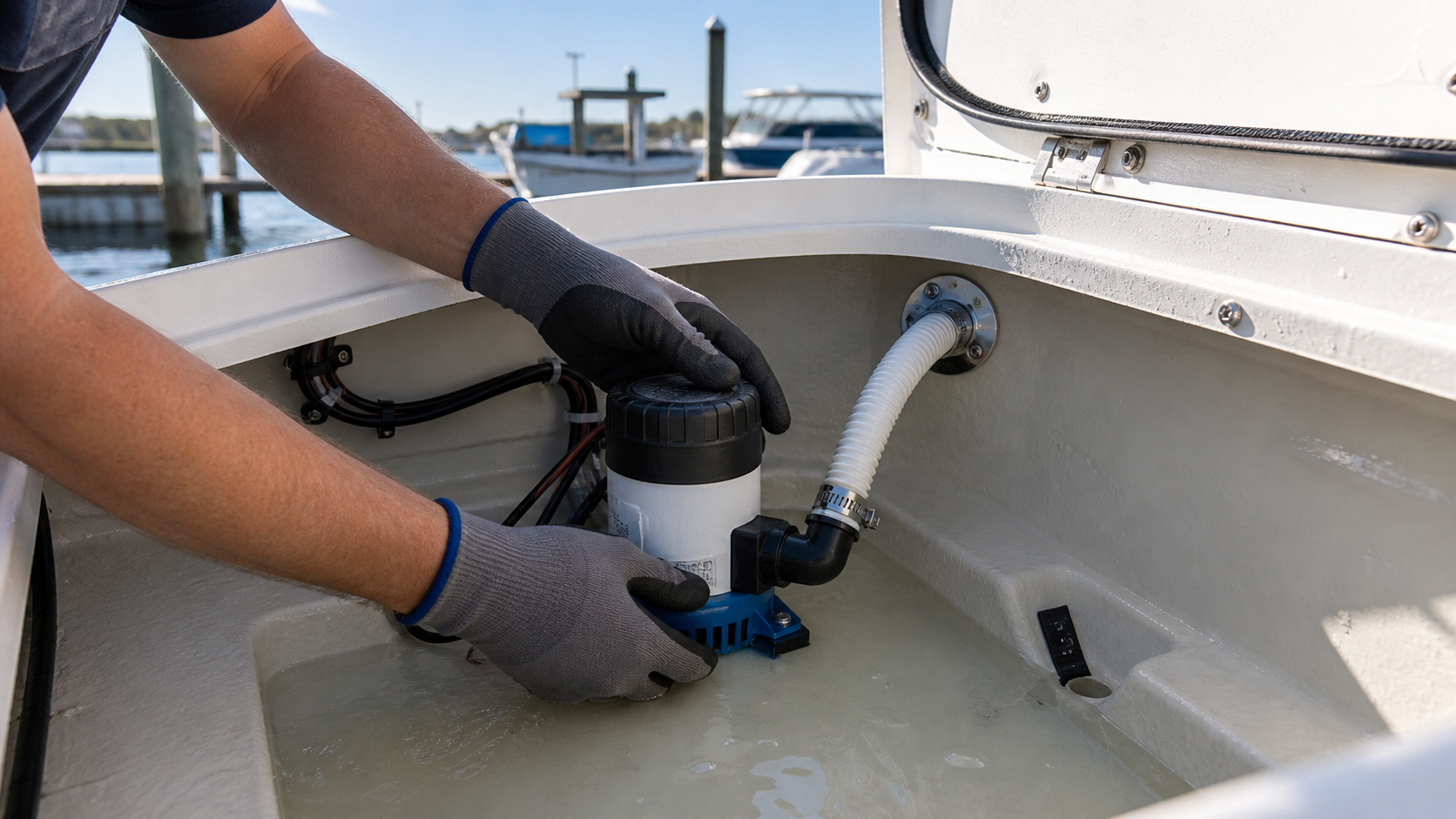
If a bilge pump runs but little or no water comes out of the hull discharge, start with the water path—not a new pump. A spinning motor only proves that the pump has power. It does not prove the impeller can pick up water, push it through the hose, or overcome the height and restrictions in the discharge system.
If water is rising, the boat is actively flooding, or the pump cannot keep up: treat that as an emergency, not a dockside troubleshooting project. Get everyone in life jackets, find and slow the source of water if it is safe to do so, use any other dewatering capability aboard, alert nearby help, and make a distress call on VHF Channel 16 or use the appropriate emergency equipment. A bilge pump is a dewatering tool, not permission to continue operating a flooding boat.
Why a running pump may not discharge water
Most small electric bilge pumps are centrifugal pumps. Their impeller must be surrounded by water and able to move that water into an open discharge line. Debris around the intake, a trapped air bubble, a kinked hose, a blocked thru-hull, weak voltage, or excessive lift can leave you with the familiar sound of a pump doing a convincing impression of useful work.
Also keep expectations realistic at the very end of a pump cycle. A typical submersible bilge pump will not remove every last puddle from an uneven bilge. The problem is different when there is clearly enough water at the pickup but no discharge—or when the pump previously moved water normally and has now gone quiet at the hull side.
Check these items in order
- Confirm there is enough water at the pump. The pump base and intake must be below the water level. A boat sitting bow-up, heeled at the dock, or carrying water in a compartment away from the pickup can leave the pump spinning in a shallow dry spot. Look for a blocked limber hole—the small drain passage between bilge sections—that is keeping water from reaching the pump.
- Inspect the strainer and impeller area. Turn off the pump circuit or disconnect its power before putting hands near it. Remove leaves, zip-tie tails, paint flakes, fiberglass debris, sludge, and anything wrapped around the impeller. Check that the strainer is fully seated and that the pump cartridge is locked into its base. A pump can sound normal while a partially jammed impeller moves very little water.
- Follow the discharge hose from pump to hull. Look and feel for a kink, crush point, loose hose clamp, split hose, or fitting that has slipped off. A loose connection can dump pumped water back into the bilge, sometimes out of sight behind a liner or under a deck.
- Look for a hose sag or air lock. A low spot in the hose can retain water and trap air above it. When the pump starts again, the air pocket may prevent the impeller from priming. The practical cure is usually rerouting and supporting the hose so it rises continuously toward the discharge, without a valley. Rule’s technical explanation of bilge-hose air locks shows why a sag can stop a centrifugal pump from moving water.
- Check the discharge fitting at the hull. Mud-dauber nests, insects, marine growth, tape, a dock line, or debris can block the outlet. Inspect from outside only when conditions are safe. Do not remove a below-waterline fitting or open a seacock without understanding exactly what it serves and how water will be controlled.
- Measure voltage at the pump while it is running. A battery can look healthy at rest and still deliver poor voltage at the pump because of corroded terminals, a tired fuse holder, undersize wiring, or a weak negative connection. Use a multimeter directly across the pump’s positive and negative leads while the pump is under load, then compare that reading with the voltage specified on the pump label or in its manual. Clean, tight connections and sound wire matter; voltage drop reduces both pumping capacity and the maximum height the pump can push against. BoatUS testing also found that installed output falls as discharge height and voltage loss increase.
Hose routing and discharge height matter more than the box rating
The gallons-per-hour number on a pump package is generally an open-flow rating: a best-case figure with no vertical lift and little plumbing resistance. On the boat, the pump has to lift water from the bilge to the discharge outlet. That vertical distance is called static head. Hose length, sharp bends, corrugated hose, small fittings, and restrictive thru-hulls add friction head. Together, they can turn a healthy pump into a weak-looking one.
Use hose that matches the pump’s discharge connection and the installation instructions for that pump. Do not downsize a hose or fitting just because it is easier to route. Smooth-bore hose, a short run, broad bends, and properly supported routing usually move more water than corrugated hose bent tightly around whatever happened to be nearby. The BoatUS Foundation’s bilge-pump system tests explain how hose type, diameter, fittings, voltage, and discharge height reduce real installed flow.
Do not add a check valve as a reflex fix
A check valve can reduce the water that drains back into the bilge after a pump stops, but it also creates a restriction. It can stick, collect debris, and cost pumping capacity when you may need it most. It is not a cure for a blocked hose, weak pump, or air lock.
Use one only if the pump manufacturer and the boat’s installation call for it. For example, Rule’s LoPro installation guidance says a check valve may be used when necessary to prevent an automatic pump from repeatedly cycling due to discharge-line backflow, but it should not be used as an anti-siphon device. That same guidance warns against combining its check valve with a 90-degree elbow because the restriction can reduce flow. Your own pump’s manual and hose-routing arrangement control here; similar-looking fittings are not necessarily interchangeable.
When the pump itself is the likely fault
Suspect the pump after you have confirmed that it is submerged, its intake and impeller are clear, the discharge hose and outlet are open, and voltage at the pump is correct while running. A worn impeller, damaged pump housing, failed cartridge, or motor that spins too slowly can all produce poor output.
Before replacing anything, write down the pump’s voltage, rated capacity, discharge-port size, automatic-switch arrangement, and physical mounting style. A replacement that has the same advertised GPH but a smaller port, different cartridge base, wrong voltage, or incompatible hose connection can create a fresh problem. If the discharge routing is poor or the boat has a long lift to the outlet, correct that system restriction before assuming a larger pump alone will solve it.
If the fault is electrical, use correctly sized marine cable and sealed terminations. Our guides explain when to use marine primary or duplex wire and how to crimp and seal marine battery lugs.
A simple dockside test sequence
- With the boat secure and the bilge accessible, run the pump manually long enough to observe the discharge outlet.
- Watch the pump and hose connections at the same time if possible; a helper at the hull outlet is useful.
- If there is no discharge, stop power and inspect the intake, impeller, hose, clamps, and outlet.
- Correct visible restrictions, then retest with enough water at the pickup to cover it.
- If output remains weak, measure voltage directly at the pump while it runs.
- Record the result and compare the installation with the exact pump manual before replacing the pump or adding fittings.
Emergency manual-pump backup
A portable manual bilge pump can help move water during an electrical failure or while you are diagnosing the installed system. It is an emergency backup only—not a substitute for a properly sized, wired, fused, and maintained installed bilge-pump system.
Affiliate disclosure: Brighter Boater may earn a commission from qualifying purchases through the following link, at no additional cost to you.
See the Better Boat manual bilge pump on Amazon. Confirm the current price, seller, dimensions, hose arrangement, and suitability for your emergency plan before ordering.
When to stop troubleshooting
Call a qualified marine technician if the pump wiring is hot, melted, repeatedly blows protection, has corroded connections buried in a wet bilge, or shares a circuit with other unexplained electrical faults. Get prompt help as well if the discharge is below the heeled waterline, the hose arrangement may allow outside water to siphon into the boat, or the boat is taking on water faster than you can identify the source.
A final habit worth keeping: test every bilge pump and high-water alarm before a trip, then verify actual discharge at the hull. The useful test is not just hearing the motor—it is seeing water leave the boat.