
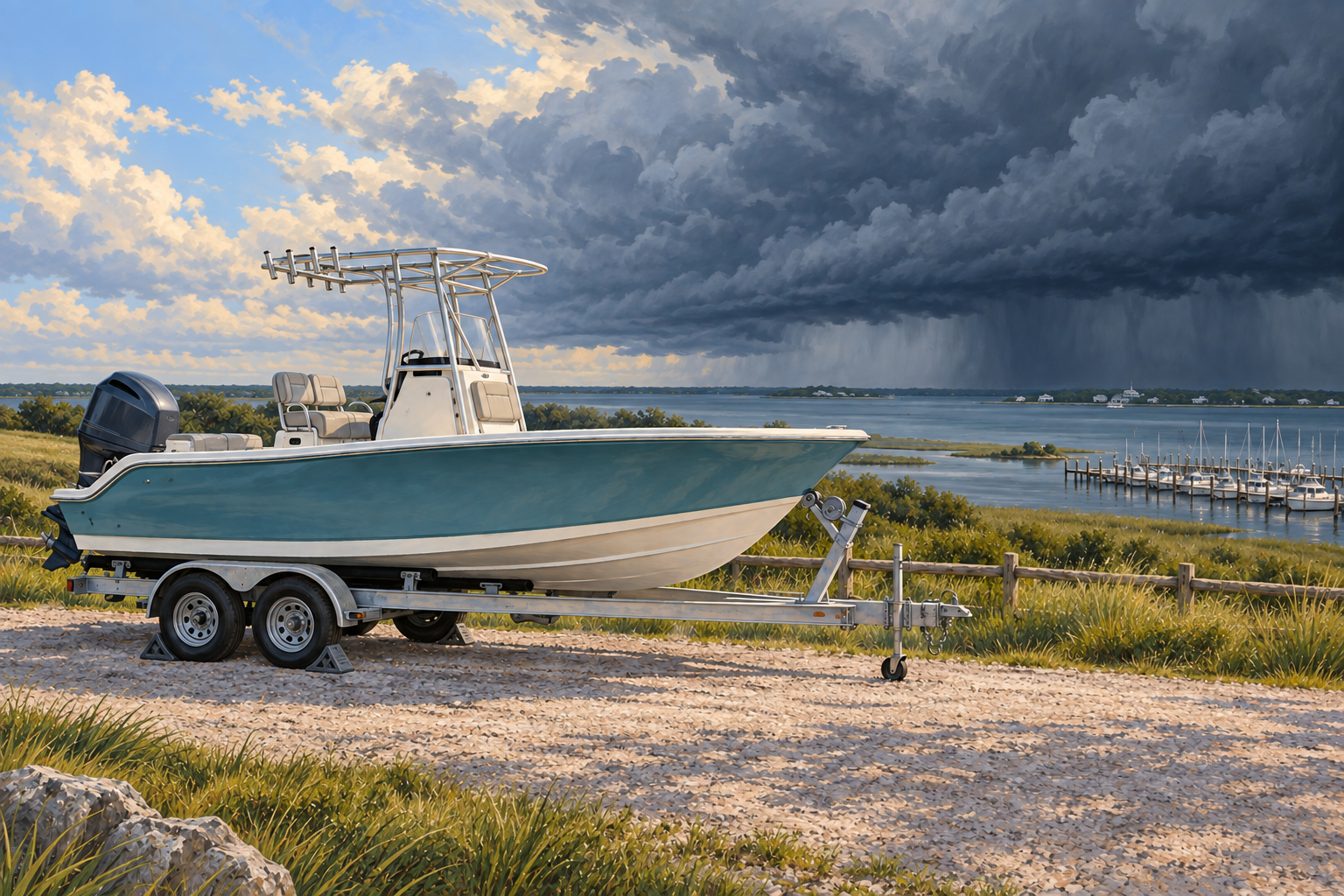
Boat storm preparation starts with a destination, a deadline and a backup plan—not a last-minute trip to add dock lines. Arrange safe storage or a professional haul-out early, reduce loose gear and wind-catching canvas, prepare for changing water levels, and leave time to protect people. Your boat insurance may help pay to move or haul the boat before a named storm, but the benefit and its trigger depend on your policy.
This U.S.-focused checklist is for recreational boat owners preparing for tropical storms and hurricanes. Follow your marina, boat manufacturer and local emergency officials. It is general education, not an individualized hurricane plan or insurance advice.
The five decisions to make first
- Where will the boat go? A suitable inland trailer location, a prepared boatyard or a marina-approved in-water storm arrangement.
- Who will move it? Name the owner, caretaker or professional—and a backup if you are away.
- When will you act? Use a written trigger that leaves room for yard queues, bridge restrictions and evacuation.
- What will insurance reimburse? Confirm the applicable endorsement, weather trigger, eligible expenses and payment cap.
- When will you leave? Set a personal safety cutoff. Never stay aboard to protect the boat during a hurricane.
A named storm does not automatically mean every policy pays, and an insurance reimbursement trigger is not a safe deadline for starting preparations.
Will insurance pay for a hurricane haul-out?
Some boat policies reimburse part of eligible professional haul-out or relocation costs; others may cover eligible precautionary expenses more broadly, up to a stated limit. Do not assume the entire yard invoice is covered. Ask about the actual policy issued for your boat, including state-specific forms and endorsements.
These insurer-published examples were checked September 26, 2026. They illustrate differences, not a ranking or a promise that you qualify.
| Insurer example | Published benefit summary | Important trigger or restriction |
|---|---|---|
| GEICO Marine | 50% of eligible professional labor, up to $1,000, for hauling or preparation. | Its claims page describes a boat in the path of a NOAA named storm, within the forecast cone; submit the invoice and proof it was paid. |
| Progressive | 50%, up to $2,000, for professional haul-out or movement to a safe harbor. | Its coverage page specifies a National Weather Service tropical-storm or hurricane watch or warning for the boat’s county. |
| Travelers | A share of relocation costs, with limits per occurrence and policy period. | Its summary specifies a watch or warning for a tropical depression, tropical storm or hurricane within 50 miles. Confirm the percentage and caps in your contract. |
| Chubb | Its boat/yacht summaries describe reasonable haul, fuel or dock costs for precautionary measures, up to the applicable policy limit. | The watercraft must be endangered by a covered peril. The public summary does not establish a universal 100% hurricane haul-out benefit or an unlimited budget. |
Sources: GEICO Marine haul-out claims; Progressive boat coverages; Travelers coverage details; Chubb boat coverage.
How partial reimbursement works
For illustration, if your endorsement pays 50% of eligible costs up to $1,000, a $1,200 eligible bill would produce $600 reimbursement; a $3,000 eligible bill would hit the $1,000 cap, leaving $2,000 to you. This assumes no applicable deductible and that every dollar in the example qualifies. Storage, supplies and other excluded charges could increase your share.
Full reimbursement of an eligible charge may be possible under broader wording, but that is not the same as full reimbursement of everything the yard charges. Obtain written confirmation of the benefit, any deductible and the applicable limit. Haul-out assistance is separate from the question of whether later hurricane damage is covered.
Ask these questions before authorizing work
- Is storm preparation included in my current policy, or does it require an endorsement?
- What exact alert, location, distance or named-storm condition activates it? Does my planned work date qualify?
- What percentage is paid, and what are the per-storm and annual limits? Does a deductible apply?
- Must I use a marina, licensed captain or other qualifying professional? Is my own labor excluded?
- Are hauling, blocking, straps, transport, storage, relaunch, fuel, dockage and reservation fees covered separately—or not at all?
- Is advance approval required, and what evidence and claim deadline apply?
- Does my policy require a specific storm plan, haul-out, storage location or navigation territory?
Keep the estimate, itemized paid invoice, payment confirmation, dated preparation photos and the insurer’s written response. GEICO Marine specifically asks for a bill and proof of payment. Do not delay an evacuation or other urgent safety action while waiting for reimbursement approval. For deductibles, exclusions and damage claims, see our hurricane-insurance guide.
Choose a safer place before the yard fills up
Ask the yard when its storm list closes, what a reservation guarantees, who is allowed to move your boat, and what happens if the lift, road or bridge becomes unavailable. A paid reservation is not itself proof of insurance eligibility. Write down a second workable option rather than assuming another marina will have space.
Trailerable boats
Move early to a suitable location above anticipated surge and flooding. Check the trailer, tires, bearings, lights, hitch and towing vehicle before they become the weak link. Avoid trees, overhead wires and ground likely to flood or soften. Follow the boat/trailer manufacturer’s and local facility’s securing instructions; simply parking on land is not a complete hurricane plan.
Boats hauled at a yard
Have the yard handle the correct blocking, stands or cradle and engineered tie-down arrangements. Ask about ground elevation, drainage and surge exposure. Do not attach storm tie-down straps to jack stands. Hauling reduces some risks but does not make a boat immune to wind, falling objects or floodwater. Connecticut DEEP’s boat-preparation guidance addresses these storage hazards.
Boats remaining afloat
Confirm that remaining in the slip or on the mooring is allowed by the marina and your policy. Have an experienced local professional assess the attachment points, line leads, chafe protection, fenders and expected rise and fall of the water. Short, tight everyday dock lines can become dangerous as water rises; excessive slack can allow collisions. There is no universal extra-line length that works for every dock.
Check floating-dock piling height and the condition of the dock or mooring system—not just your own lines. If the site cannot accommodate the expected conditions, more fenders are not a substitute for relocation. BoatUS explains why the storage location matters so much.
The last safe visit: reduce wind load and keep water moving out
- Remove removable canvas, covers, sails and loose deck gear; secure remaining equipment according to its instructions.
- Clear scuppers and drains. Test automatic bilge operation and check battery condition.
- For an afloat boat, do not switch off the battery supply needed by its automatic bilge system. Close appropriate seacocks without disabling necessary drainage or bilge discharge; get boat-specific guidance if unsure.
- Close hatches and ports. Turn off unnecessary equipment and arrange safe shore-power disconnection before conditions deteriorate.
- Photograph the boat and preparation, remove valuables, and keep insurance and ownership records off the boat.
These checks complement—not replace—a suitable storm location. Chubb’s preparation guidance covers drains, pumps, power and documentation. If you find a pump problem, use our bilge-pump troubleshooting guide before the weather closes in. A pump cannot compensate for major flooding.
Watch the wind-arrival forecast, not just landfall
Use NOAA’s National Hurricane Center, your local National Weather Service office and emergency-management instructions. Hurricane watches are generally issued 48 hours before the anticipated onset of tropical-storm-force winds; warnings generally 36 hours before. Those are alert definitions, not a recommendation to wait.
The forecast cone describes uncertainty in the storm center’s track, not the full area of damaging conditions. Wind, surge and flooding can extend outside it. A policy may use a cone-related trigger even though physical danger extends beyond the cone. Read NHC’s explanation of its forecast graphics and make preparations early enough to finish safely.
Before leaving: a 60-second check
- Boat location and contact person confirmed.
- Marina/yard storm plan and policy conditions checked.
- Lines, chafe points, drainage and automatic bilge supply checked as applicable.
- Loose gear removed; preparation photos and paid receipts saved off-site.
- Family evacuation plan ready; nobody remaining aboard.
After the storm, return only when authorities permit access. Avoid damaged docks, downed wires and potentially energized floodwater. Notify the insurer promptly about damage and ask before authorizing salvage or permanent repairs. Our boat-sinking insurance guide explains why salvage and damage coverage are separate questions.
Bottom line
Make the marina call and the insurance call early. A reimbursement benefit can make a planned haul-out more affordable, but neither insurance nor extra rope makes last-minute storm work safe. The boat can be replaced. You cannot.
Editorial illustration: AI-generated concept showing relocation away from the water, not a complete tie-down or storage design. Insurance summaries checked September 26, 2026; the issued policy and endorsements control. No insurer sponsorship is implied.