
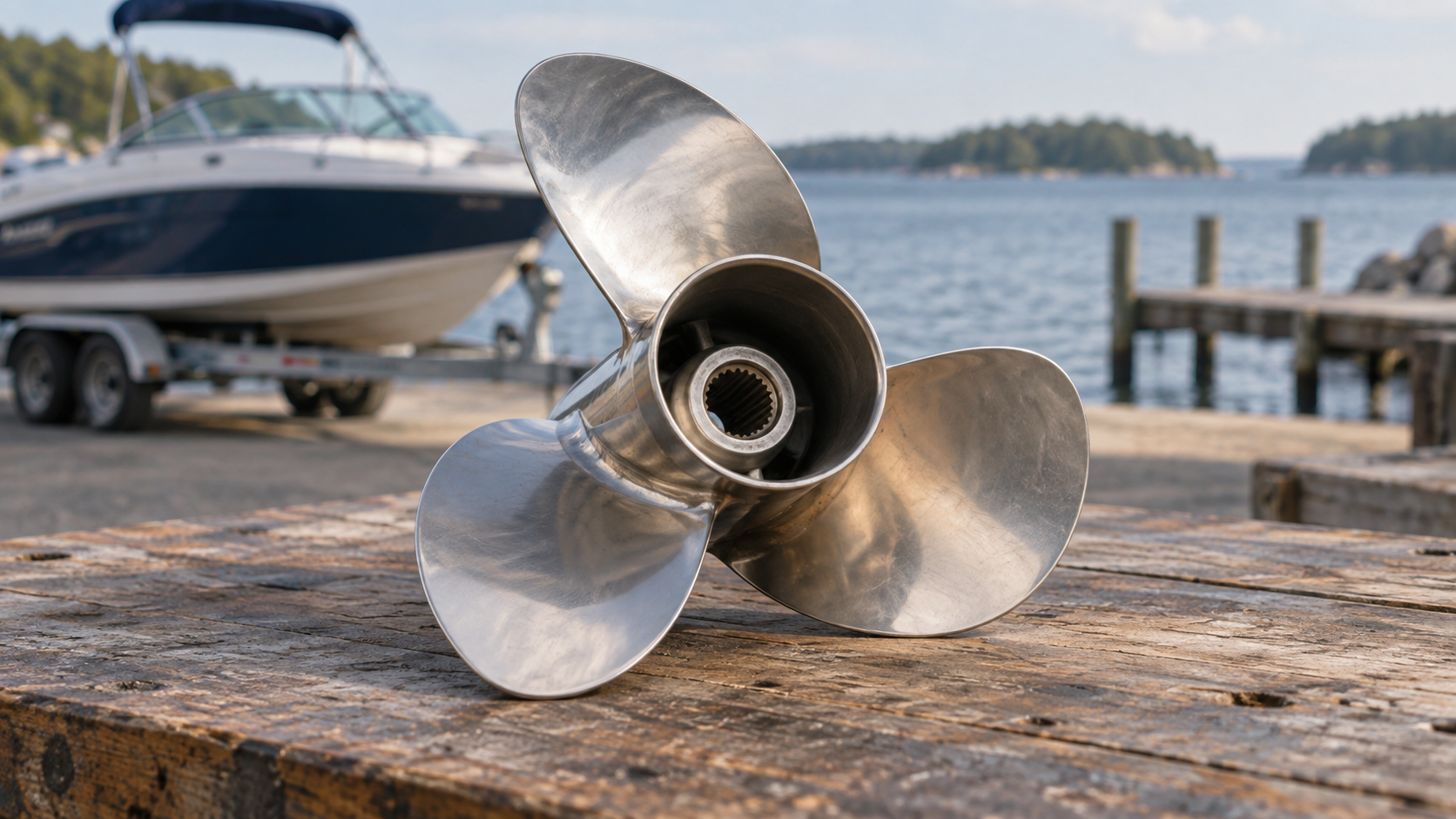
If the tachometer jumps, the boat stops pulling, and your first thought is “the prop is cavitating,” pause before naming the problem. An abrupt RPM flare during a turn, in chop, or with the drive trimmed high may be ventilation: the propeller has ingested surface air or exhaust gas. True cavitation is a pressure-related vapor-bubble problem at the blade itself. A damaged propeller, a slipping hub, or an engine-height/setup issue can produce similar complaints, so the useful clue is usually when the symptom happens.
The short version
- Ventilation: Usually a sudden, clean-feeling RPM flare with a sharp loss of bite. It commonly begins when trimming out, turning hard, crossing a wake, running light, or operating in aerated water. Reducing throttle and trimming in often lets the prop bite again immediately.
- Cavitation: A low-pressure condition on the blade creates vapor cavities that collapse as they move into higher-pressure water. It can reduce thrust and contribute to noise, vibration, and blade erosion, but it is not simply “air around the prop.”
- Prop damage or fouling: Often produces vibration, reduced performance, or a repeatable loss of thrust that does not depend neatly on one turn direction or trim setting.
- Spun hub: Engine RPM rises but boat speed does not follow, often under hard acceleration or heavy load. The propeller may look perfectly fine.
- Setup issue: A motor mounted too high, excessive trim, disturbed water reaching the propeller, or the wrong propeller geometry can make ventilation more likely.
Use the terms precisely
Ventilation is air or exhaust reaching the blades
A propeller works by creating a pressure difference across each blade in solid water. Ventilation happens when surface air, exhaust gas, or heavily aerated water reaches the blade. The blade suddenly has less dense water to work with, so propeller RPM rises and thrust falls.
Mercury describes ventilation as surface air or exhaust gases introduced around the propeller, causing propeller speed to increase while boat speed drops. It lists excessive trim-out, a high-mounted drive, a missing exhaust-related component on applicable drives, and damage that leaks exhaust into the propeller area among the possible causes. servicelit.mercurymarine.com
Ventilation may be associated with a particular condition: a sharp turn, trim angle, steep following wake, hard acceleration, a light fuel load, or rough water. Yamaha’s service guidance likewise identifies turning, high engine mounting, and load changes as ventilation triggers. global.yamaha-motor.com
Cavitation is a local pressure problem
Cavitation occurs when pressure on part of the blade falls below the vapor pressure of the water, forming vapor cavities. As those cavities move into higher-pressure water, they collapse. That collapse can create noise, vibration, lost efficiency, and—when it occurs close to the metal—erosion or pitting. Michigan Wheel explains how excessive cavitation can damage blade surfaces in its cavitation guide.
The distinction matters because a cloud of visible bubbles behind the boat does not prove cavitation. It may simply be ventilation, exhaust, wake aeration, or all three. True cavitation is difficult to confirm from the helm alone; a propeller specialist may use the blade’s damage pattern, operating data, and sometimes controlled testing to separate it from ventilation.
What the symptoms usually tell you
| What you notice | Possible cause—not proof | What to check next |
|---|---|---|
| RPM suddenly jumps in a hard turn or when trimmed out; thrust returns when you trim in or ease off. | Ventilation | Trim angle, engine mounting height, turn direction, rough-water conditions, and whether the prop is ventilating from surface air or exhaust. |
| RPM rises on hard acceleration, but the symptom is not especially tied to trim, turns, or chop. | Hub slip, damaged propeller, or a driveline issue | Inspect the prop and hub. Record RPM and GPS speed. Check for propeller-to-gearcase fitment issues on the specific engine or drive. |
| Buzzing, rumbling, or new vibration at a particular RPM; performance is down everywhere. | Blade damage, fouling, bent shaft, or cavitation related to a damaged leading edge | Inspect for fishing line, weeds, dents, missing material, raised burrs, and blade-to-blade differences. Do not keep running a prop that suddenly vibrates after a strike. |
| Loss of thrust begins after a prop strike, even though the prop looks mostly normal. | Hidden blade distortion, hub damage, bent shaft, or gearcase damage | After securing the boat and preventing starting, have the propeller and shaft checked by a qualified prop shop or technician. |
| High RPM and poor speed only at high trim or with a raised jack plate. | Ventilation or setup limit | Ease off the throttle, note the settings, and have the installation evaluated. Do not repeatedly provoke a loss of thrust. |
What to do when RPM flares and thrust drops
Ease off the throttle and keep control. Check your surroundings and passengers. Avoid abrupt steering or repeatedly accelerating to recreate a loss of thrust. Once safe, note the trim setting, turn direction, load, water conditions and whether it followed a strike or recent propeller work. A passenger can record observations; the operator should watch the water.
New vibration, overheating, unusual mechanical noise or persistent loss of drive calls for inspection, not a full-throttle trial. If you cannot proceed safely, arrange assistance. After a strike, hidden damage can extend to the shaft and gearcase; see BoatUS guidance on underwater impacts.
Inspect before buying a propeller
With the engine off, key removed, the boat secured, and starting prevented according to the engine manual’s stop-switch and ignition-isolation procedure, inspect the propeller before deciding it needs more pitch, more cup, or more blades. Remove the prop if the manufacturer’s procedure permits and you have the correct tools; fishing line can hide behind the thrust washer and damage a prop-shaft seal.
- Look along each blade edge for nicks, flattened sections, cracks, chipped coating, and raised burrs.
- Compare blades for matching shape. A blade can be bent enough to matter without looking theatrical from three feet away.
- Check for weeds, line, shell fragments, or other debris around the hub and gearcase.
- Inspect the gearcase for impact marks, cracks, and areas that could disturb water flow or, on applicable drives, allow exhaust into the propeller stream.
- Check the propeller hardware, thrust washer, spacers, and hub components against the engine or drive manufacturer’s parts diagram. A prop that fits the shaft splines is not automatically the correct installation.
Mercury specifically lists debris, a bent blade, and raised burrs or sharp propeller edges as common cavitation causes. servicelit.mercurymarine.com
Could it be a spun propeller hub instead?
The hub connects the shaft to the propeller and cushions loads. Depending on its design, impact, age or excessive heat can damage it. A failing hub may still transfer enough torque at low speed, then slip when more power is applied. Reducing throttle can therefore seem to fix both ventilation and hub slip temporarily.
Mercury’s explanation of propeller hubs also cautions that excessive heat can point to another engine or cooling problem. Hub designs differ: a pressed-in rubber hub and a removable hub kit are not serviced the same way. Have the actual assembly checked instead of ordering a generic replacement by horsepower alone.
When setup is the real problem
Ventilation is often blamed on the propeller when the propeller is merely exposing a setup limit. The most common variables are engine mounting height, trim, jack-plate height, hull design, loading, and the quality of water arriving at the prop. A stepped hull, tunnel, transom notch, bracket, or water crossing the gearcase can send aerated water toward the blades.
Propeller design matters too. Diameter, blade area, rake, trailing-edge cup, blade count, and venting all change how a propeller carries load and holds water. More cup can help a propeller retain bite in some applications, but it also acts like added pitch and can reduce wide-open-throttle RPM. That is a tuning tradeoff, not a universal cure. mercurymarine.com
Do not raise an outboard or choose a more aggressive prop based only on a cleaner-looking rooster tail or one impressive top-speed pass. Confirm that the engine reaches its manufacturer-specified wide-open-throttle RPM range with the boat loaded as it is normally used, while maintaining adequate cooling-water pressure where the manufacturer provides that data.
When to quit troubleshooting and get help
Schedule professional propeller or drivetrain inspection if there is a prop strike, a cracked or badly bent blade, repeated unexplained over-revving, gear-lube contamination, a leaking prop-shaft seal, a bent prop shaft, or vibration that was not there before. Stop operating if the engine overheats or loses required cooling-water pressure. Have mounting-height changes evaluated by a qualified technician. A propeller problem can be a performance nuisance; a damaged shaft seal or gearcase is a much more expensive dockside lesson.
Before choosing a replacement propeller
Diagnose first, buy second. Confirm the exact engine or drive, shaft size, rotation, propeller family, hub kit and required hardware. A prop that fits the shaft splines is not automatically the correct installation. For the next step, read our propeller pitch and WOT-RPM guide, three-blade vs. four-blade comparison, and, if relevant, our guide to leaning on plane.
Sources and further reading
- Mercury Marine owner information on cavitation, ventilation, and common causes
- Yamaha Motor service guidance on propeller ventilation conditions
- Michigan Wheel: cavitation mechanism and causes
Reviewed September 12, 2026. Featured image: original AI-generated editorial illustration, not a product photograph or an example of diagnosed damage.