
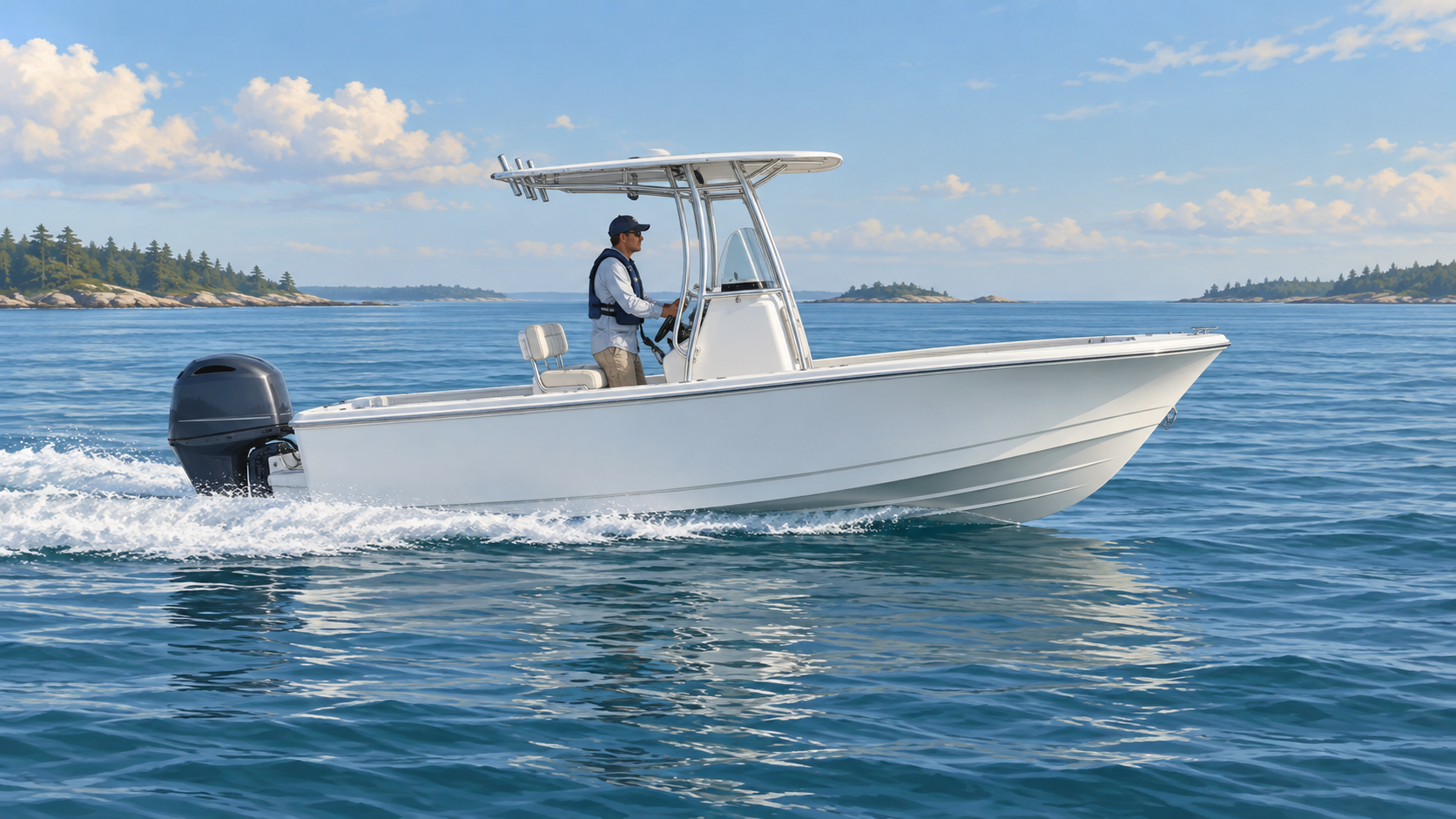
On most outboard- and sterndrive-powered planing boats, trimming down brings the bow down; trimming up tends to raise it. Start with the boat and engine manufacturer’s recommended takeoff setting. After the boat settles on plane, make small adjustments and allow time for the hull to respond. The goal is a controlled, comfortable running attitude—not the highest trim-gauge number.
This guide explains engine or drive trim. It is different from changing propeller pitch, raising an engine on a jack plate, or adjusting the separate trim tabs on the transom. Your boat’s manual and a qualified instructor’s on-water demonstration take priority over a generic rule.
What does the trim button actually change?
Power trim changes the angle of the outboard or sterndrive relative to the transom. That changes the direction of propeller thrust and influences how the boat rides. It does not change the blade pitch stamped on your propeller. Think running angle, not an extra throttle control. Discover Boating explains the basic trim mechanism.
| Control | Drive movement | Usual effect on a planing boat |
|---|---|---|
| Down / in | Lower unit moves toward the transom | Lowers the bow; can help the boat climb onto plane |
| Up / out | Lower unit moves away from the transom | Raises the bow; can reduce drag once the boat is on plane |
| Tilt / trailer range | Raises the drive farther out of the water | Not the normal operating range for running on plane |
The effect is not an unlimited benefit: both extremes can create handling problems. Mercury’s owner manual distinguishes trim from tilt and details the control hazards (printed pages 33–35). That manual applies to the engines listed on its cover; use the manual for your exact model.
A practical sequence: set, settle, tap, reassess
- Set up before accelerating. Choose clear, sufficiently deep water and suitable conditions. Secure passengers and gear, keep a lookout, and use your life jacket and engine cut-off system as applicable. Select the recommended takeoff trim. Many conventional planing boats begin trimmed in, but do not turn that into a universal “hold DOWN until it stops” instruction.
- Let the boat settle on plane. Accelerate smoothly within the conditions and local restrictions. If the bow blocks your view or the boat struggles, do not keep adding power while guessing at the controls.
- Make one small adjustment. At a steady, appropriate cruising speed, a short trim-up input may improve the running attitude. Release the button and wait for the response before adding another input.
- Read the boat, not just the gauge. Notice forward visibility, steering feel, ride, speed and engine sound. A more dramatic bow angle or spray pattern is not proof of a better setting.
- Reassess when something changes. Load, speed, turns and water conditions can change the useful trim setting. If handling deteriorates, ease off and regain a stable ride rather than pursuing another speed increment.
Mercury’s trim guidance recommends small changes while learning how the boat responds. This is a familiarization exercise, not a wide-open-throttle test.
What too much trim looks like
Too far up: the bow may begin a repeating up-and-down bounce, called porpoising. The propeller can also lose its grip as air reaches it. Ease off and, when safe, reduce excessive trim-out. Do not accelerate through instability. A sudden RPM flare is not automatically cavitation; our ventilation versus cavitation guide also covers slipping hubs and other look-alike symptoms.
Too far down: the bow can dig in, drag can increase, and steering may become unpredictable. More DOWN is not always safer. Mercury warns that excessive trim-in can cause bow steering or an unexpected turn. If the boat feels unstable, reduce speed and restore control; persistent problems need inspection or instruction.
Do waves change the answer?
Yes. A setting that feels good on smooth water may be unsuitable in chop or with waves coming from behind. Some bow-down adjustment can soften the ride into short chop, but burying the bow in following seas creates a different hazard. Speed, course and conditions matter at least as much as trim. There is no single “rough water” gauge setting. America’s Boating Club explains these running-attitude tradeoffs.
Engine trim is not the same as trim tabs
Engine trim changes the drive angle. Traditional trim tabs are plates near the bottom of the transom; lowering them creates lift at the stern. Independently controlled tabs can also correct an ordinary side-to-side running imbalance. Their switches may be labeled for the intended bow response, not which plate is moving.
Automatic systems add another layer: some control engine trim, some control tabs or interceptors, and some coordinate multiple devices. Learn what your system actually does and how to take manual control. Do not copy button sequences from a different boat. BoatUS compares traditional and automatic trim systems.
If the issue is a persistent lean, especially one present at rest, do not use tabs to conceal it. Start with our boat-lean troubleshooting checklist.
Common questions
Should the trim gauge be in the middle?
Not necessarily. Gauge calibration, hull design and loading differ. Treat the display as a repeatable reference on your own boat, not a universal target. Premier’s pontoon manual, for example, describes the gauge as a general guide and warns against excessive bow-down trim. Pontoon behavior should not be assumed identical to a V-hull’s.
Can I adjust a manual trim pin while moving?
No. Stop the engine and secure the stationary boat; follow the exact adjustment and support procedure in its manual. Power-trim button advice does not apply to a manual pin arrangement. Keep clear of the drive’s movement and pinch points.
Does trimming up mean I need a different propeller?
No. Trim is an operating adjustment; propeller selection is a separate fit and performance decision. If you are evaluating a replacement, use our propeller-pitch and manufacturer RPM-range guide. First rule out loading, damage and setup problems.
Bottom line: small input, time to respond, then reassess. Trim for control first and efficiency second. If the boat demands extreme settings or suddenly handles differently, stop guessing and have it checked.
U.S.-focused recreational-boating education. Reviewed September 14, 2026. Featured image is an original AI-generated editorial illustration, not a measured trim-setting demonstration.